Archive for July, 2012

Expedition Yemen By Camel; Meeting Al Qaeda in Rumah and the Expedition Ends

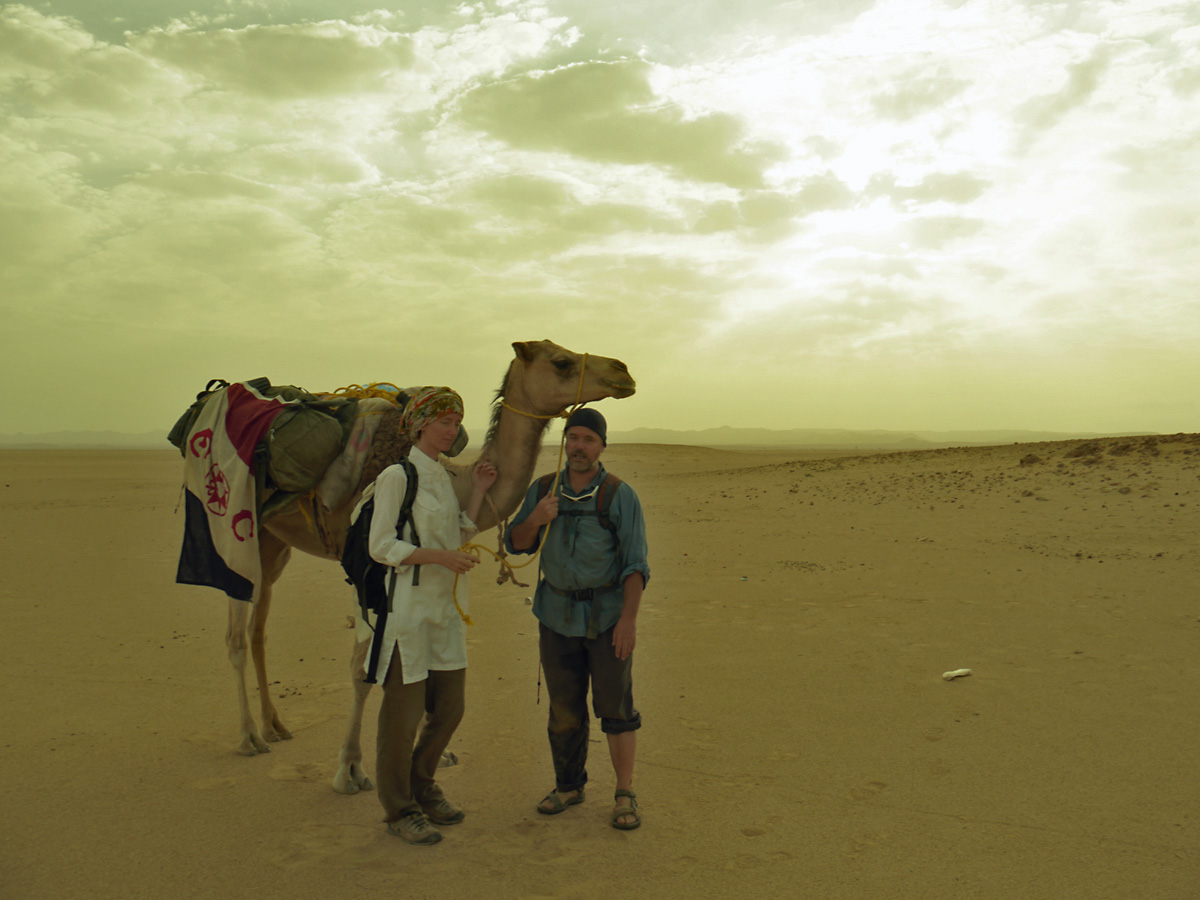
”I will miss sleeping under the stars” , Tanya said whilst we were cooking our last dinner under a moonlit sky full of stars and a clear Milky Way, but she finished her dreamy comment with a reality check; “But on the other hand, travelling through the desert is most of the time like a prison. The heat and lack of water forces you to stay on track leading to other people to be able to survive. The freedom of the open spaces is really completely off limits.”

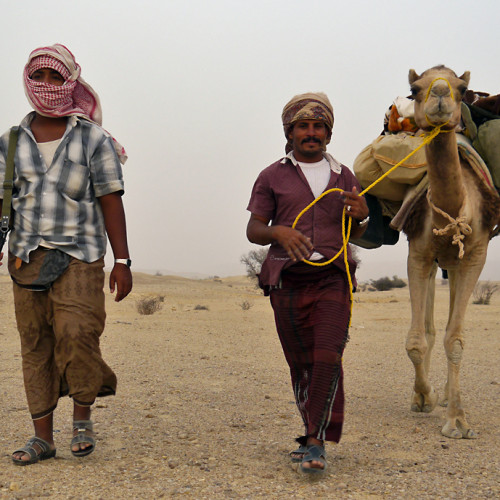
Sheikh Saleem was praying again. Today he had prayed more than the compulsory 5 times. He was worried about entering Rumah which he considered full of evil and he continuously reminded us to get out of there as soon as possible. We had already decided that we would give Kensington to him as a gift. They were already best friends and Saleem had taken over the job of feeding and packing him more for every day that passed. And we allowed him to do this, since we knew he was the best solution to where to leave this fantastic travel partner we had named Kensington after one of my sponsors, Kensington Tours. We had received offers from quite a few Bedus who wanted to buy him, but almost wherever we came, we were told by the people living there, that it would be a great idea to give Kensington to Saleem. Our friend was liked and venerated by everyone. And the more we got to know him, the more we really liked him. He was extremely talkative like most Bedus, but had all the great assets for which the Bedus are famous. He was loyal, brave, had great humor and patience, he was very generous and the last day he asked Tanya if it was true what he had heard through the grape vine, that I had problems with my economy. Because if that was the case, he told Tanya, he would lower his wages by half. What a human being!

However, when we met him the first time, we got into a serious argument. We had made it halfway and already agreed to take on another guide, when Sheikh Saleem turned up and demanded to be the guide, since he was the best. The whole nomadic tent camp we stayed at that night agreed and told us with passion that he was a religious man who everyone along the route venerated and admired. He was a much better man than the one we had picked. Our choice wasn´t even a Bedu, he came from Shabwa, they said. And he would just get us into trouble with other tribes along the route. But we insisted. However, after walking just a kilometre the following day we noticed a jeep parked next to the track and at the same second we passed it, we crossed an invisible border and the driver told us aggressively that we had entered another tribes area who didn´t allow us to continue. The only one who could provide us with safe conduct through this apparently hostile country was Sheikh Saleem. And so he have done throughout the trip! We haven´t paid one single meal, overnight stay, even though we have asked if we could!

You really get to know each other on a trip like this one, where the surroundings in every way, demand all your energy. All the best and worst sides show up. I did have some worries before setting off as regards to my partner Tanya, who had never been on a hard Expedition, but on the other hand, had many years of living in the Arab World and three years in Yemen. But still, there´s a clear difference from living outdoors doing hard physical work in a relatively unknown environment each day and since I have had many partners throughout the years, good and bad, I also knew that a good partner had nothing to do with your experience, it is all up to your attitude, but I was still worried. Which, as usual in my case of continuously worrying about things, was a waste of time. Tanya turns out to be one of the best partners on an Expedition that I have ever had. Most of all, she had the right attitude, a positive outlook, like me almost naive, as regards to life ad Yemen. She was also very independent minded with a strong view on all aspects of life, which I appreciate a lot, and the idea from the beginning, that we would supply different views of our trip turns out perfectly. But she was also very fun, always extremely charming and sensitive to her surrounding and I honestly didn´t have one boring and sad moment with her. I am extremely privileged to have had this time together with this fine human being.

The last three days was the hardest of all the walks, since we had put our minds of doing almost 30 km:s a day. This was also the stretch where we initially didn´t have any nomadic Bedu Camps along the way and we had some worries how to get water, but Bedu jeeps passed us on and off, so that turned out to be a small problem. We basically hurried through Wadi Nahrit and zoomed up north through Wadi Armah and scenery was beautiful. The distances weren´t a real problem, but it took its toll on Sheikh Saleem and at one stage he got really upset and shouted;

“Mikael, you are a big man and this is too hard for the rest of us!”

That was the only time on the whole Expedition where any of the guides told me the truth that they were tired! They always complained when walking next to Tanya, but didn´t want to appear weak in front of me, so after moaning for her, who always sent them directly to me with their complaints, but when they came to me, they said instead:

“The woman is tired. I think we need to rest.”

I told them, she is fine. We will continue. They would then fall back to Tanya, whine about me being like a machine, wait half an hour and come up to me and say:

“The camel is tired. I think we need to rest.”

Let me just say, after coming across a lot of camel people on earth, the Bedu are the best. They genuinely respect their camels. When two Bedu meet they rub their noses against each other as a respectful greeting. The same applies when they greet a camel. I never saw a Bedu treat a camel bad. Most camel people globally use a nose peg to control the camel, but not the Bedouin. They don’t need it, since they love and treat them accordingly.

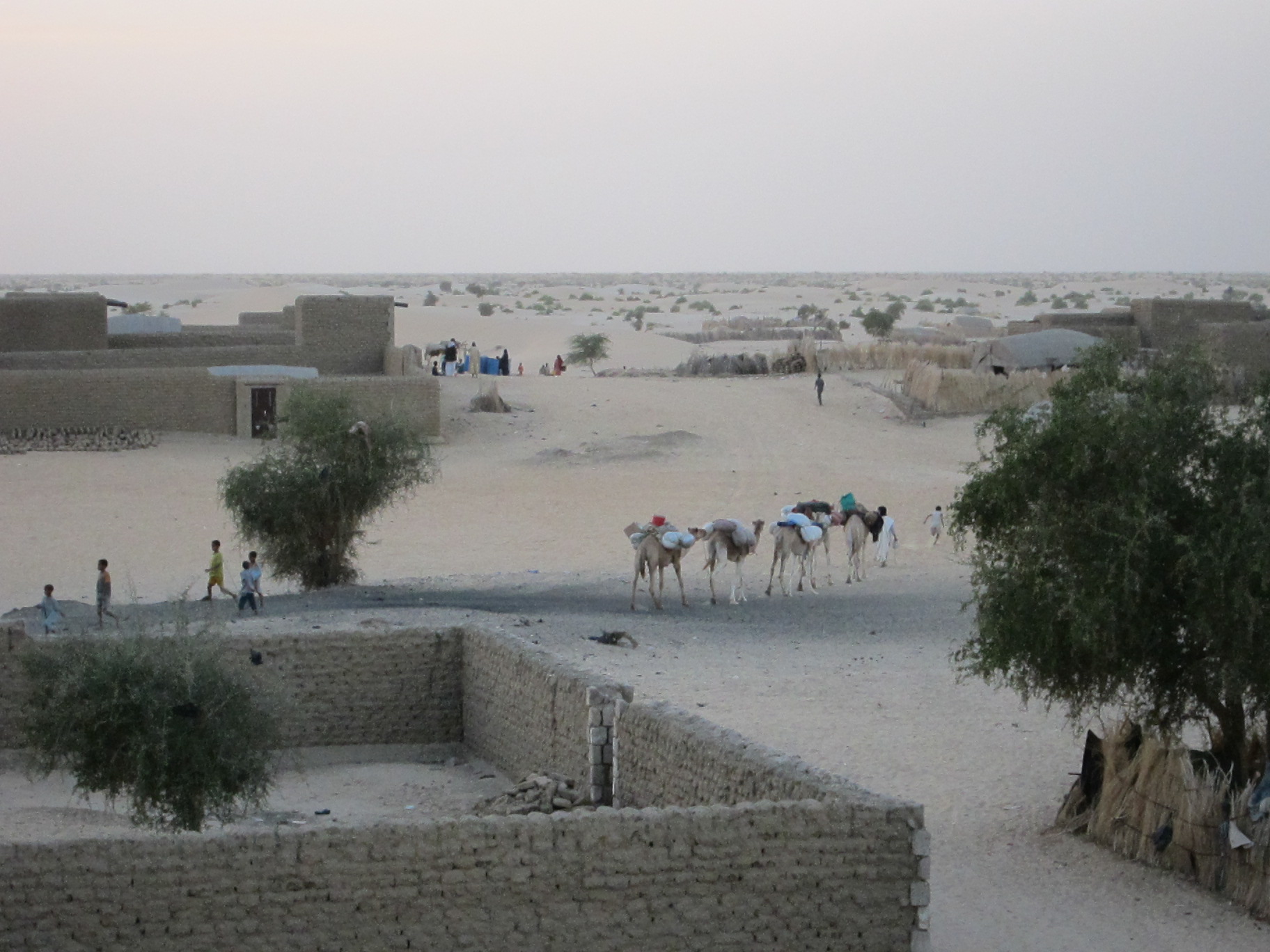
The last day was the hardest. We did 7 hours though the midday heat and when we arrived at Rumah, we were all knackered. But we got surrounded by a small crowd of people in cars, following us and scaring Kensington which immediately got diarrhea from anxiety and Saleem said he wanted to get out of this place as quick as possible. He was clearly very worried. Rumah was kind of a crossroads place in the middle of the desert in the state of Hadramawht, where we were not allowed to be, due to the worries concerning the presence of Al Qaedah. We parked Kensington at a hotel parking, had a quick lunch, repacked and gave Saleem all the equipment we didn´t need anymore, he complained it was too much and then we cross the road in front of the hotel to say goodbye to our partners on route, on a crowd turned up in no time, as did the police and wanted to see our papers and talk about Al Qaeda.

“You cannot be here” , the police man said; “You have to leave now and I will drive you myself to Al Ghaydah.”

We didn´t like the idea, since we knew that the police often were involved in kidnappings in Yemen, so we managed to get out of it and talk us into staying a night in the hotel.

“You can´t leave the room!” Sheikh Saleem told us sternly and it was hard for him to leave, he was that worried.

Eventually he left with a worried Kensington, waving goodbye with pain, but I am sure he and Kensington both looked forward to return to the stillness and solitude of the desert again. We did! And, yes, there was some worries about Al Qaedah, even though we really didn´t believe in their existence as far east as here! So we did a walk around the little desert town which felt very Gulf alike looking to buy all food and drinks we had dreaming about for almost a month and at one shop, the curiosity of a journalist like Tanya took over and carefulness and of course she asked if Al Qaeda was in town!

“Oh yes they are, they have a house here in Rumah!” the shopkeeper said with a big smile and added to my worry: “I can take you there if you want! “

“But aren´t they dangerous?” Tanya asked and they shook their heads in unison and said clearly; “No, they´re good people!”

Slightly shocked and a bit worried, I much more than Tanya, who didn´t believe them, we left the shop after finding out that the bus to Al Ghaydah left between 7-9 the following morning and we went back to the hotel. We knew somebody would knock at the door soon. Either the police or Al Ghaydah. In either case it would mean problems. But nobody knocked at the door until next morning and, of course, we woke up in readiness, but it was the hotel who noticed we were on the edge of missing the bus. So we packed in a hurry, ran to the bus station, where everyone was still eating breakfast, sitting down on mats, people told us it was full, but the Turkish bus driver fixed us with the best seats of couse, this is Yemen and with Turkish kindness, it is even better! We bought the tickets in the same shop where we had been told the day before, that Al Qaeda was in town, so Tanya with her sharp mind rephrased her question and asked if Ansar Al Sharia was there and in shock they shouted back at us;

“No, they will never be able to get in here! They are not here!”

We entered the bus in surprise, but suddenly realized after a call to our friend Mohammed in Al Ghaydah that they most likely were talking about a family which came from the village near Taizz called Al Qaedah! So much for terror organisations planning to kidnap us! However, we still felt some anxiety of reaching the first road block, since we didn´t have a permit to be in Hadramawht, but Tanya told our Turkish driver, who sorted that out with ease and also invited us for lunch at the next stop.

I just love Yemen! And the Bedu!

Expedition Yemen By Camel; Meeting Al Qaeda in Rumah and the Expedition ends

 ”I will miss sleeping under the stars” , Tanya said whilst we were cooking our last dinner under a moonlit sky full [...]

Expedition Yemen By Camel; Marriage offer with a 12 year old

“She is almost white like you and she goes to school, so she is educated” , Sheikh Saleem Hamid Ambe Somota Al Mahri told me, he then grabbed my arm, looked me in the eyes with seriousness and said: “Please, take my daughter with you to your country and leave Tanya with me here. She will become a good Muslim.”

“Don´t leave me here!” Tanya shrieked half jokingly since she had gone through quite a demanding time since we arrived to this small Bedu settlement Al Arabah and I answered our new guide quite weary knowing his daughter was only 12 years old: “It is haram (forbidden) in my country. You have to be 18 years old to be able to marry and we cannot have more than one wife.”

Sheikh Saleem looked very surprised and tried again to persuade me again, since in his book of life, it would be a good move for a father to marry his daughter to what he most likely thought was a life together with a well to do foreigner. Somebody who not only could take care of his daughter but also one who would take care of him and the rest of his family. This move I can fully understand. It is a question of pure survival and there´s a saying among the Bedu which says it all:

“A guest fed in one’s own tent today may be the one who can provide food tomorrow.”

I shook my head again. He looked sad, looked forlornly at Tanya, realized his new dream would never happen, but he didn´t bring the subject up again, ever. He was a really good human being, one of the best I have ever met. Warm, kind, intelligent, generous and extremely loyal. And he knew his camels. He was an old bahout (leader of camel Expeditions) who once used to lead big caravans between Al Ghaydah and Rumah, our chosen route. It ended with the arrival of the car, but in those days he brought food, salt and other necessities on up to a 100 camels shared between 50 men. I am sure it was as complicated to travel together with two foreigners and one camel, because every day we in one way or the other questioned things of life which were the only ways he knew. At times, like this instance, he was to shocked to have an answer. Other times, he would say:

“I don´t understand because I am not educated.”

This time he walked back in silence to the eager and curious crowd who was sitting on the front porch belonging to a rich camel owner who everyone called Ali Ali. He was one of very few Bedu I actually disliked a lot. We had met him once during our negotiations to buy a camel in Al Ghaydah and didn´t like him at that time either. He was one of these human beings who is convinced he know better than everybody else. Of which we have quite a few in Sweden, so I know them well. They have no wish to listen to others, but are convinced they know the truth. And in this case Ali Ali told us, Tanya specifically since she spoke Arabic, that Islam was the only way. It didn´t matter that we tiredly pointed out that he couldn´t read and write and actually never read the Quran. And all his tries ended up with Tanya referring to a sura (passage) in the Quran stating differently. He walked off in anger, when I told him it was time to move on with life and that was the beginning of the most demanding time of our trip. Ali Ali instigated a virtual flood of women trying to persuade Tanya to leave me and become a Muslim. (We had chosen to say that we were married to avoid problems, but as a whole it complicated more than it was of help) He also tried to make us look bad in front of all the other people, saying we, especially me, which of course was right, that we were non-believers and this is of course not a very good thing to be when among a crowd with a non-educated view of Islam. Tanya and Sheikh Saleem talked us out of it, because we did realize that Ali Ali was our host and as generous as all the other Bedus and showered food and tea upon us throughout the 24 hours we stayed in the village. Enough time to rest, have a shower, was all the clothes and recharge all needed batteries. Sheikh Saleem kept a watchful eye on us all the time and I was happy he was a part of our team, which by now had done 2/3 of the trip to Rumah.

The hardest part was still ahead of us. Up until this moment we had done the easiest part of the Expedition from Al Dabin to Al Arabah. It had been one week of extreme heat, some vicious sand storms, but great desert scenery. However we were getting more adapted to the heat by each day out in the Sands of Mahra. Finally we were doing the 20 km a day we needed to be able to feel we were getting closer to Rumah and hopefully we would make it back to Sanaa before the Ramadan. A wish everyone of us had, since walking a full day without food would have been impossible. But our speed, 5-6 km/hour and no rest when walking, had already finished of 3 guides until Sheikh Saleem turned up. Our first guide, the amicable Mabkhout returned to his family when we reached Al Dabin, to some degree because his 8 month old daughter needed more vitamins and but most of al due to the fact that he was scared of the Bedu tribes waiting outside the Kelshat area he knew. And he was scared he would eventually die but the hard work and the sun. He often brought up he had seen Mohammed, our friend from Al Ghaydah, being hit badly by a sunstroke, left us and worried he would go down the same road. So he returned home and left us in the hands of a young fat Bedu in Al Dabin, who´s father was a rich local sheikh who bragged continuously, and the sons name was Mohammed Oman. He knew absolutely nothing about camels, he lied excessively, he did manage to cause unnecessary injury to poor Kensington by tying him to hard before I could take over and he did virtually nothing but complain. But he still cost us a 100 US a day. But we had no other choice but to take him with us, since this practice of safe conduct and passage in between the different tribes is as old as the Bedu themselves and is called sayyara. Bertram Thomas and Wilfreid Thesiger who both passed through the same area back in the years of 1946-47 talks at length about it. It still exists. So does the generosity of the Bedu.

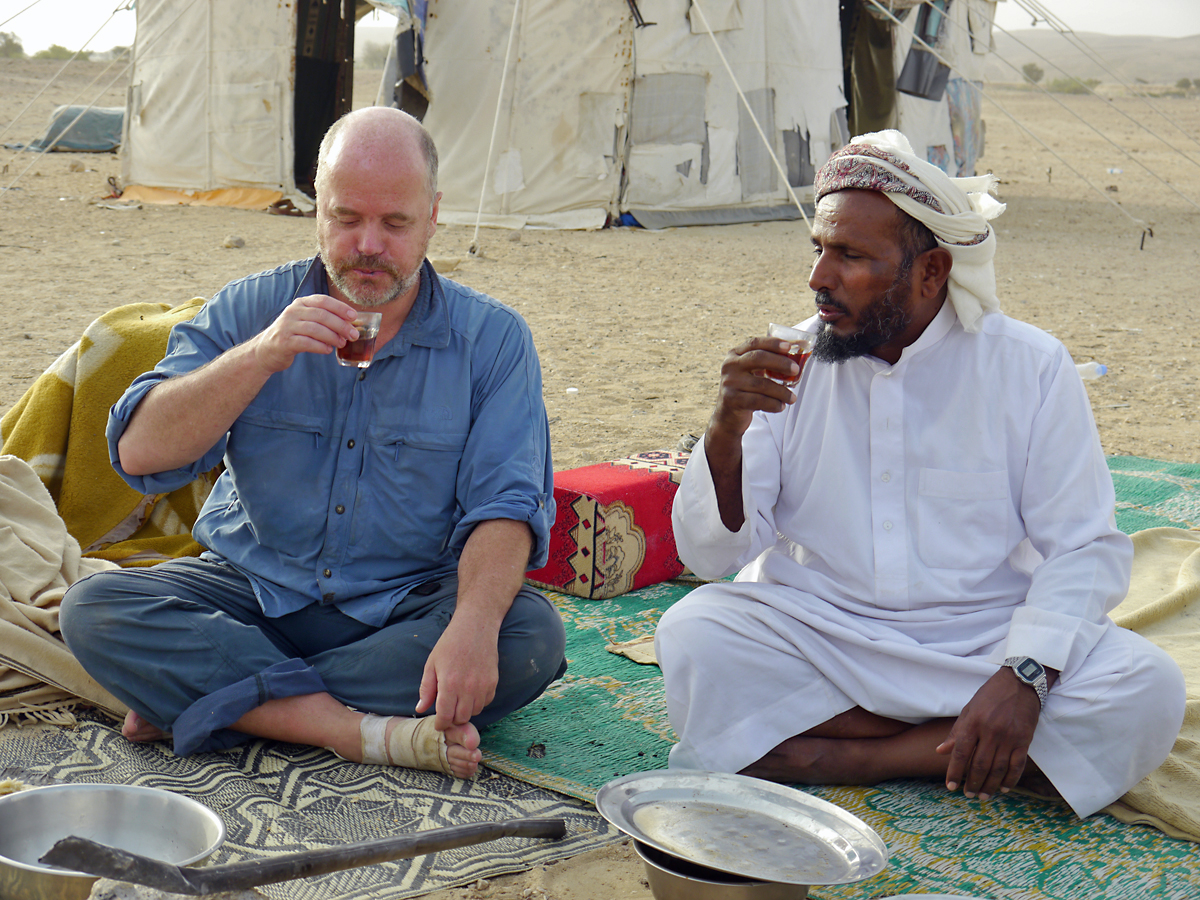
No matter where we turned up, whether settlements or Nomadic tent camps, we were always offered camel milk, food, the scarce water and grazing for Kensington. We never paid a cent. Only Mohammed tried to complicate matters wherever we came due to his sheer youth, exhaustion and stupidity, but we managed to get him kicked out from a Nomadic camp since he caused us a major embarrassment by his lies. This was the first time we met Sheikh Saleem, which was described as a highly religious and pious man who knew everything about camels. And he was known by everyone in Al Mahra and thought to be the best guide of all. But, Mohammed had fooled us and we had hired another guide, which we promised the job of joining us. A great and very pleasant fella, but all this caused us to end up in a serious argument with Sheikh Saleem.

We where at that stage very close to be forced to turn back and give up our journey.


Tanya and Al Ali…..

Expedition Yemen By Camel; Marriage offer with a 12 year old

“She is almost white like you and she goes to school, so she is educated” , Sheikh Saleem Hamid Ambe Somota Al [...]

Where the Camel Meets the Canoe By Steve Kemper

Whilst preparing to set off on the crossing of the Sands of Al Mahra, I received this email from the well known [...]

Expedition Yemen By Camel; Poor Me!

 Poor me By Tanya Holm I am about to fall asleep when Saada Saida tells the other women that I have no [...]

Expedition Yemen By Camel; Poor Me!

Poor me

By

Tanya Holm

I am about to fall asleep when Saada Saida tells the other women that I have no mother. Where she got it from I don’t know. We have known each other no more than a few minutes, since Mikael and I arrived with our guide, Muhammed al-Kathiri, to her settlement with the camel Kensington. I have introduced myself and said only that Mikael and I walk through the desert in hope of learning something about the landscape, culture and preferably its people.

“Poor her,” says a girl.

I have no strength to talk of my family. In Yemen it takes long before conversations about them end. There are plenty of follow up questions.

“Is your brother taller than you?”
“Is your father taller than you?”
“But not your mother, right?”

Other questions asked on the trip are the following.

“Would your family reject you if you changed your religion?”
“Would your husband beat you if you said you want to live in Yemen all your life?”

“Will you be put in prison when you return to your country, because you have lived in Yemen?”

I lay on a plastic rug next to a few tents and a simple built house of grey bricks. Saada Saida has given me a heavy blanket to rest my head against. Her family sits around. Muhammed al-Kathiri tells me off.

“Men don’t like to see women lay like that,” he says.

I have walked the same 16 kilometers as he has. I have no strength to sit up and I tell him so.

“You can lay with your butt in another direction than the men’s,” explains Saada Saida, quietly.

I find a proper position for myself.

“I am your mother,” she says and caresses me over the hijab.

I can barely see her. The fluorescent lamp cuts into my eyes, tears are running to my cheeks, not because I am sad, but because it burns awfully when one has eyes full of sand. That the sun took my vision away during the day might have something to do with it. Saada Saida has the cure.

“Drink tea!”

She is in her sixties. She points to the legs and arms and stomach and says “sick.” I say “poor you” and finally I fall sleep.

Poor, “maskina”, is a word I hear a lot in al-Mahra. The women we meet obviously pity me. Maskina, they say about me, arriving in men’s clothing. I’m given several sets of thin cotton dresses with matching shawl. Maskina, they say when they hear that I am the only woman walking with one, two, three men. They invite me to the women’s tents and wedding parties. Maskina, am I who smell so bad. I cannot count the number of times they spray perfume on me and tell me to wash myself.

One evil hot day amongst others a fashionable woman drives up to me in a little jeep, for a chat through the window. We are the same age, I think, and she is dressed in bright purple, except for a small, black face veil that brings out the eyes like nothing else. Her watch would be far too big for a raven to grab, but you would think one would try to go at it a number of times. The woman has gold on most of her fingers. Quickly she hands over a large glass bottle of perfume. It looks expensive; I don’t want to waste any so I spray only once on my neck.

“More!” she says.

I obey.

“It’s necessary,” she says.

I spray yet another time. Then I give her the bottle but she will not accept it.

“It’s a gift,” she says.

She soon drives away in the desert.

I never cease to be amazed at how clean the Bedouins are, with washed and scented clothes, despite the very scarce water resources.

“Do you pity also Michael?” I ask a few women.

They look surprised and say nothing.

“Do you pity Kensington?”

He is a camel, they say.

There is nothing kind about al-Mahra’s June sun and one is no more than an ant underneath it. It is not the walk that is the hardest; I’ve walked, camped and enjoyed the outdoor life before. But the heat, around 50 degrees Celsius, drains. Several hours a day, I lie down just to breathe, a gasping breath. Sometimes I get the strength to yell. It feels good. But it changes nothing. I yell at Mikael who thinks his 25 years of travel experience, and knowledge about the desert, is of interest to me. “I don’t care!” The reason I neither want nor ask for advice is because I’m like most people: unless I find my own way, I’m deeply unhappy.

At times drinking seems unnecessary. It’s as if the body is punctured again and again. The water runs straight through the skin. My thirst disappears. I cannot drink the water that is hotter than piss. Instead I bark at Michael who nags at me to drink and eat and drink even more.

“Do not tell me what I should and should not do,” I say.

Then I throw away the vitamin tablets he gives me. One must obtain a little damn integrity even though on “expedition”.

When there is not even a tree to shelter under, or a mountain, and the sun reigns above so one’s shadow disappears under the feet, then also I feel a tiny little, little bit sorry for myself.

Maskina, the women say when they see me.

“Yes, poor me,” I answer.

When I am lucky there is a Saada Saida around to mother me.

Expedition Yemen By Camel; Extreme Heat and The Bedu

Proper layout and video plus images to be found at http://www.mikaelstrandberg.com/2012/07/16/expedition-yemen-extreme-heat-and-the-bedu/

“I just feel cheated all the time” , I said to the camera slightly upset, at the same time as we walked out of the village called Marayt and I added almost in despair; “These never ending negotiations about every little thing is killing me!”

For a short while we walked through a lush area of date farms and it felt like walking through some kind of a paradise. Mabkhout, our guide, was very happy that we had agreed to raise his daily wages by double compared to earlier, a 100 US a day, and up until that moment, all my comments about the beautiful desert had been received non-committal. Walking through this greenness he looked genuinely happy and this was his image of paradise, not the extreme harshness of the desert. Suddenly a strong wind arrived at the same time we passed though a narrow, fenced off area, Kensington panicked and threw off all the gear and Mabkhout screamed:

“Djinni, djinni!”

I don´t know if he thought it was bad djinns or good. but this was the beginning of a changed attitude for Tanya and myself. Tanya had heard my daily report for the camera and was both upset and worried as regards to how we dealt with life. I agreed. We were to negative and had problems adjusting to both the Bedu way and the heat. So, at that precise moment, we changed our attitude and decide from now on do what we were supposed to do. Travel through Bedu Land (Al Mahra) with an open mind, positive attitude and realize that we were visitors there to leave a good impression plus do a positive documentary about the region. I realized I was far to orientalist and down right stupid. How could I ever believe that my Western way was the only choice how to see life? And didn´t I understand the ways of the land?

We needed Mabkhout, because through him we had, first of all, full protection and identity of his tribe, the Kel Shat. Without that it would be more difficult to pass through this area. (the Bedu said it would be impossible for us to pass through by ourselfs, but I disagree. They´re so friendly the Bedu, all over the place, so we would have made it through by ourselves. ) Secondly, by travelling with Mabkhout, we learned the ways and thoughts of the Bedu. Which was one of the main aims for us to be there. And I was finally beginning to understand what a unique Expedition we were doing. The Bedu traditionally believe they are the descendants of Shem, son of Noah, whose ancestor was Adam, the first man and the Bedu are by many seen as the original Arabs, a people who lived in the area called the Middle East before any others. And, there was no doubt, I had the same feeling travelling amongst them as I had with the maasai, who I lived together with for a long time in Kenya and Tanzania. Let me first say that the Bedu like the Masai are integral parts of modern society through satellite discs, mobile phones and so on, and I don´t wanna fall in the traditional orientalist trap of calling them untouched and original,because these is far from the case, but based on my experience from over 120 countries and 25 years of professional exploring, I had this unique feeling which is hard to pinpoint, but, as with the Masai, it felt like I was coming close to the origins of human kind, as regards to how they saw life, but maybe not lived it. It was kind of raw and basic. As the heat in itself. Which we became acutely aware off next day!

”I have to get out of this heat!” screamed Tanya; ”I can´t stand it. I will die out here!”

My thermometer showed 48 degrees Celsius. Our throats were sore, dry and hurting. Sweat was pouring down the body even when we were sitting dead still under the makeshift shadow we had created by hanging a blanket between two thorn trees. The time was around 11 and it would just get hotter by the hour up until 3 p.m. when it would cool down enough for us to feel alive. I knew from experience, if we don´t drink 1,5 litres per hour during the hottest hours, cramps, sunstroke and a gruesome death would eventually follow. But to be able to get drinking water, we had to pump it through a filter to be sure we wouldn´t get ill. And the water had been picked up in a dirty well the night before, so it took 20 minutes of hard work, to get a litre to drink. Worst of all was the strong sunlight, which was especially hurting Tanyas eyes and I knew that it was strong enough to permenantly cause blindness if we didn´t take care. I had taped her sunglasses early in the morning with duck tape to avoid sunlight to bounce off the sand into her sore eyes whilst walking and ruining her vision. Walking was out of question between 8 a.m. and 4 p.m. Not surprising, considering the brain stops to function when reaching 45 degrees. In an hour we would have problems just breathing, it would be impossible to think and good decision-making was out of the question.

“You just have to accept it, Tanya” , I told my partner, who´s first Expedition this was; “There´s no other way, but to suffer and wait until it gets bearable.”

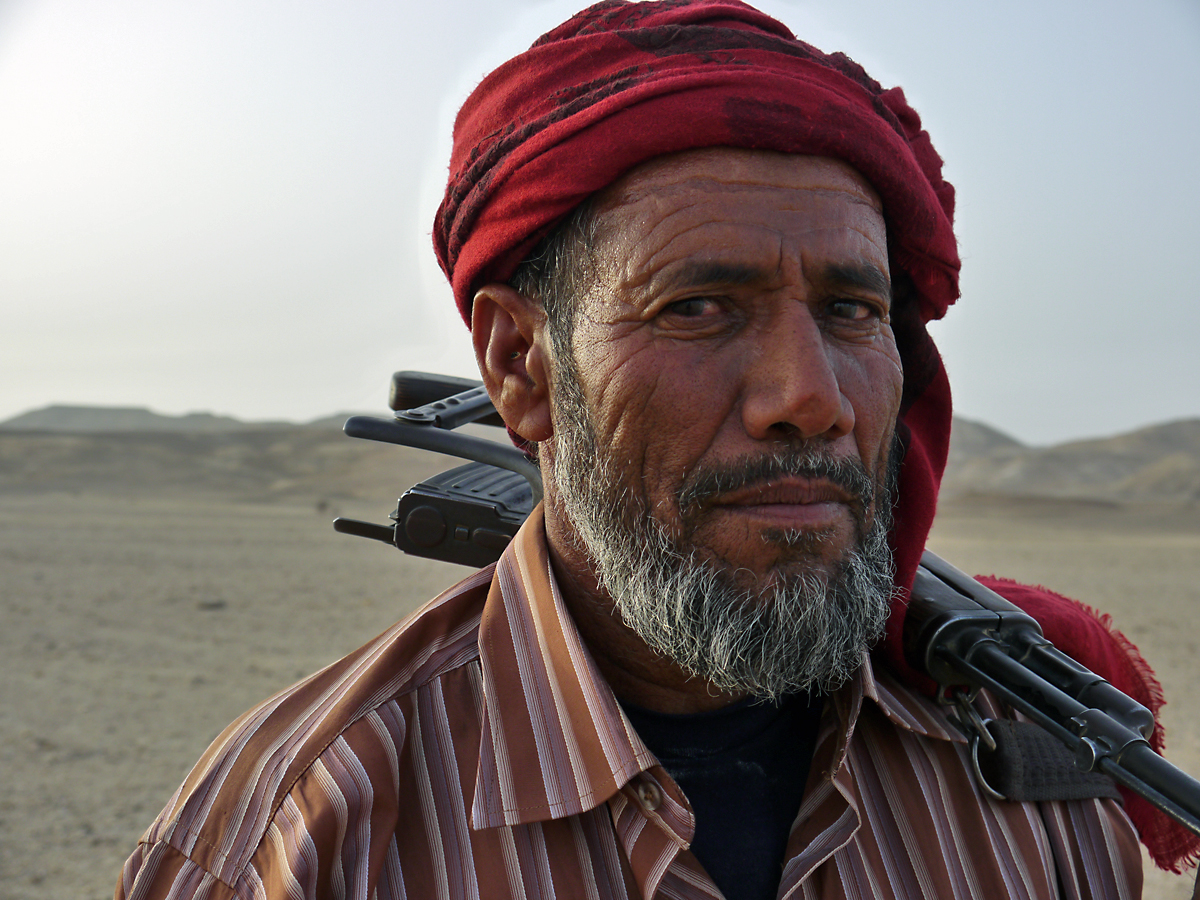
For Mabkhout, this extreme heat was a major part of his life. He knew nothing else. This is the life of the Bedu. Extreme, raw and frugal. And he didn´t see any beauty in the landscape. For him, this was hell. But at this stage he was happy having a job, because he has been out of work for quite some time. His life hadn´t been easy. He had two wife’s right now, 4 kids with each of them and a few months old daughter. The reason he took this job. To be able to buy he needed nutrition’s, because he knew the value of this, since he was the only surviving child in his family. All his other brothers and sisters were dead. But the more we got to know, the better we liked him and I started to understand why he fought so hard for a raise. he needed it to survive. I would have done the same. And he was very open with his ups and downs in life. He had been in prison in Oman for three years. He had been fooled by a rich Omani to smuggle stuff over the border and had been caught. He wasn´t welcome in Oman anymore and disliked the place a lot. His dream was to invest in a car and drive professionally again. But, right now, life was hard. He hadn´t bought a new futa for almost a year and it was even longer since he bought a new shirt. We carried almost 40 kg:s of personal equipment, but Mabkhout brought absolutely nothing but his Kalashnikov. When he saw all our equipment the first day of packing, he wanted us to at least get rid of the tent. Bedus don´t need a tent he said. We pointed out we needed it to keep out technical equipment safe and working. And after initially dismissing my GPS as useless, since it couldn´t find neither water or good grazing, he was by know utterly impressed with how I could pinpoint were we were on the map, which was in English and not much better than a piece of sandpaper, and he was impressed with my ability to tell him exact distances we had walked. He would spend a fair part of his evenings in front of a campfire bragging for other locals about this map and ability to give exact distances walked from the first day we had started our journey.

Our new positive attitude made a major difference in many ways, but it should also be said that Mabkhout was part of the positive change, because from now on he did pretty much all negotiations and did it extremely well. Wherever we came from now on, as regards to nomadic camps, we never ever had to negotiate or pay for food, grazing or water. Not even petrol for our stoves. And the visits to the nomadic tents were the highlights of the trip. The Bedus here were just incredibly generous, friendly, charming and helpful. We could later meet the same Bedus in a settlement and there, they wouldn´t be as great. Which shows that the life as a nomad as far better than settled life!

After 5 days of hard walking, accepting the heat and enjoying this life much better by the day, we arrived at the small settlement of Al-Dabin. And went to a Bedouin wedding. And Tanya got accused of using her sunglasses to unauthorized film the wedding! More about this on Friday!

Expedition Yemen; Extreme Heat and the Bedu

“I just feel cheated all the time” , I said to the camera slightly upset, at the same time as we walked [...]

Expedition Yemen By Camel; Buying Kensington The Camel

Full layout at www.mikaelstrandberg.com

”It looks younger than you say” , I told the crowd watching me walking backwards, checking the camel who had been offered for 2500 dollars and added; ”But it is really placid and cuddly.”

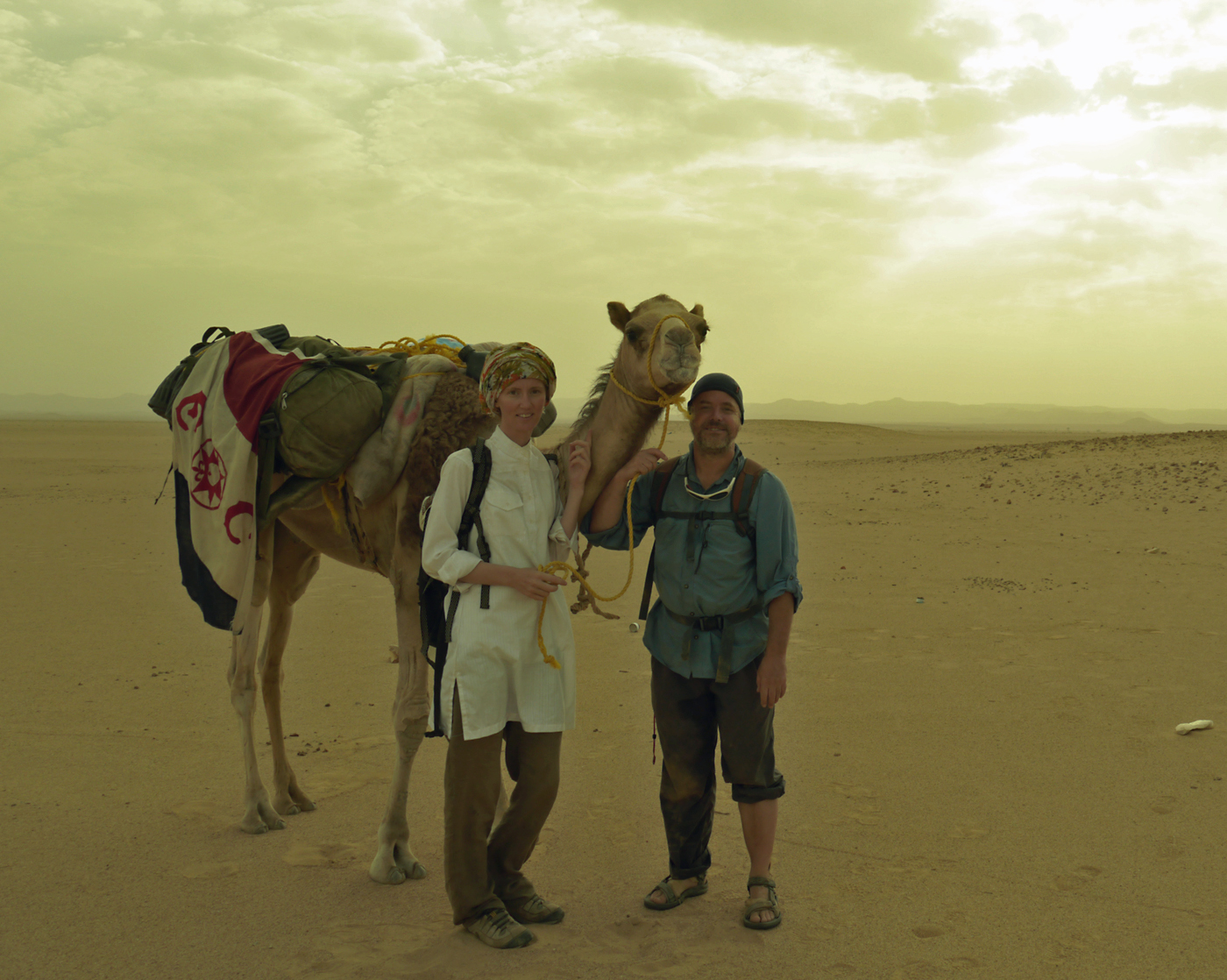
The Bedu crowd protested when I questioned that this not fully grown male camel was younger than the 4 years they suggested. Nobody knew exactly, but after awhile, I agreed, this young camel teenager was perfect for us. We named him Kensington after a friends company, who had sponsored the Expedition with this camel. Kensington was a charmer. Small, but well built, he had walked some distance with gear and had been ridden a lot, according to the people selling him, which was a first for us to hear, since we came to Al Mahra. So far we had seen many camels, but none used to long distance walking with gear. Kensington had small ears, a big mouth, cute and very curious eyes and a strong big hump. I didn´t find any injuries anywhere, except the scars after far too big branding marks on his left cheek and long neck. He was one of the calmest camels I had ever come across and even Tanya, who still wasn´t too comfortable being close to these beautiful animals, could pat him without him getting angry, wanting to bite her like all the others. Camels, like other animals, fear people who are scared and behave irrationally. I also noticed he didn´t have a nose peg, which made me happy. That meant these guys knew how to handle camels. And, of course, the Bedus are the real camel people on earth, who´s spirit is closely related to this fine and proud animal. Something we didn´t really understand at this stage. We were still fighting what we saw as a life of injustice because we were foreigners. We felt everyone was trying to rip us off. We still hadn´t adjusted to the way the Bedu´s live. Basically meaning:

Time has no end.

They can wait for years to take a desicion. So why hurry taking desicions? Bedus are considered by many as the most indigenous of the Arabs or people of the Middle East, by which I mean, they probably lived here before anyone else. The first appearance of nomadic peoples in the Arabian desert is said to be traced back as far as the third millennium BC.

”Ok, we want him”, I said and everybody seemed happy.

But how to get him back to Marejki, where we were supposed to start our journey?

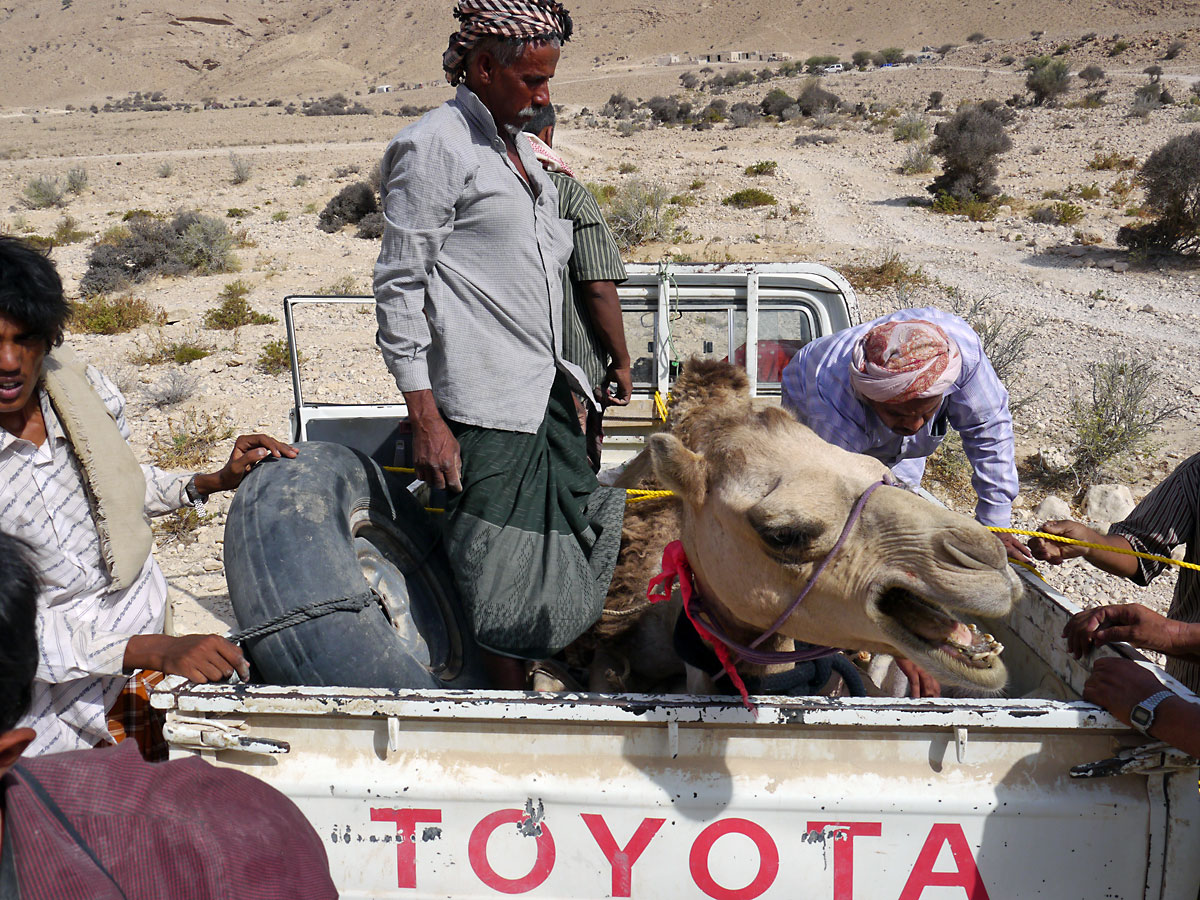
It was 4 hours really, really rough desert and mountain road away. Of course they loaded poor Kensington, who was furious and full of fear, on the back of a HiLux and than we set off the 4 hours back to our starting point. It wasn´t the most perfect of beginnings, because we had travelled 2 rough hours of road from Al Ghaydah to Marejk and from there, 4 hours to this mountain settlement to see Kensington, buy him, and now travelling back. And I was really worried how this bumpy and uncomfortable trip would do to the mind of the young Kensington. Maybe it would scare him for the rest of the life? Make him freak out every time we saw a car? The desert environment is harsh and does not lend itself easily to the support of human life. It was scary how lifeless and barren it was. Twice we passed some date farms, but that´s it. The rest was hostile desert. Well, we did see stray camels everywhere. And goats and sheep. Which are the traditional job of the Bedu. Raising these animals and finding food for them in the desert. It seemed an impossible jobfrom the beck of the jeep, where Mohammed our friend from Al Ghaydah and our body guard/guide Mahood, was sitting, singing songs from this extremely rough desert region. But, of course, I knew by experience that despite these harsh conditions, a great deal of life animal and plant life manages to exist in the desert. All we saw now was mountains, rock outcroppings, gravel and stony plains, wadis (dry riverbeds, which can become sudden torrents during a heavy rainfall), and stands of scrubby bushes or trees. I also knew that after a rainstorm, the desert floor explodes into a carpet of grasses and brilliantly colored wildflowers. But, when I asked the driver, when they last had rain, he answered:

“We haven´t had rain for three years”

After this he brought up the subject that he wanted to get payed for driving us back and forth to this hidden mountain refuge where we bought Kensington.

We knew we had to get up early next day, to avoid the heat and I was still nervous, since I still hadn´t seen the saddles and the saddle bags they said would be part of the deal. Next morning I woke up at 5 to be shocked. The saddle consisted of 2 blankets. Of course they had no rope, so I brought out my yellow colored back up one, which Mahood cut into pieces immediately before I could do something. The same happened to one of the harnesses a friend of mine, Marianne, had given to me to use on this trip and in shock I saw what they considered pack saddles, meaning they did they old basic set up. Only 2 blankets and a piece of rope made a saddle, with a home made girth holding it to the body. And I immediately realized they would then use the equal balance technique and that no saddle bags existed. So we had a bit of a row. At the same time, it was getting much hotter and we were still far from being used to this oven.

After 300 meters of walking the equipment fell of the camel with a big thump! I was furious, feeling cheated again and being dead worried that this would cause Kensington a lot of damage on his hump area. We had far too much gear, so we got rid of some stuff, like the duck tape, which would have helped us later on. Mohammed put a bit of the left overs in his already heavy rucksack, the type kids use for schoolbooks. But he had as many books. All about Islam. On top of this, he carried his customary Kalashnikov, which he probably never had used.

We repacked quickly, but the sun was getting real mean, temperature showed 40 and it was just 7 in the morning. The same thing happened after another 500 metres and this time, I angrily demanded to do it all by myself and amazingly enough managed to get it to work. The problem was the 40 litres of water we carried. All together Kensington carried around 75 kg.s on his maiden trip, far too much, but we had no idea where we would find water next, even if we were in a Kel Shat-area, the home tribe of Mahood and Muhammed. After an hour the heat was immense. My thermometer showed 46 degrees Celsius and we were all really knackered, after just 4 kilometres of walking, we took a 7 hour lunch break, hiding from the burning sun under a former river bed wall.

I think we were all more or less in a state of shock. Tanya kept up her charming spirit up, but there was no doubt she was suffering in this intense heat. Muhammed was really, really knackered. The speed was far too high for him, who had never walked many metres in his life and at the same time was quite overweight. Mahood seemed to have lost some spirit that morning through our quarrels. Bedus are no fans of heated discussions and upset tempers. I personally felt that kensington was far too heavy, we were too many on this trip on one camel and we were moving at a snails speed. I wanted to average 20 km.s a day to be able to have all options open what to do all the time. I was also unsure of the exact route to take. We knew that Rumah would possible be the end of the trip, due to the worries as regards to Al Qaedahs movements in the Hadramawht. But at that moment, Rumah seemed impossible to reach.

Kensington wanted to return to his mountain retreat and birth place during lunch, so Mahood almost went all the way back to Marejk to pick him up. He had hobbled all the way there and when Mahood came back to our place in the shadow, I went out to take the exact GPS coordinates and Mahood came up to me, slightly curious to what I was doing. So I explained the satellites in orbit around the globe and that this little item exactly could tell us where we were. After a minute of silence, Mahood asked me:

”Does it tell us where we can find water?”

Slightly surprised I said no and this made Mahood look me deeply in the eyes and he said:

”What good is it if it doesn´t tell us this?”

I have to say, this is probably the best remark I have ever come across. Modern society meets the Bedus! This was also a big eye opener for me as regards to my irritated behavior.

”I didn´t sleep at all during the night!” Mohammed said next morning whilst we were cooking breakfast.

Porridge. Loved by me, hated by the rest. Mohammed wanted to return home. It was harder than he had expected, but we talked him into continuing. We told him this was a great chance for him to see his own land and country plus that he would do great as a translator of the local tongue mahari into Arabic, which Tanya would translate for me. Her work rate was impressive and I was wondering how long she would be able to keep it up, because this life as an explorer was all new to this great human being.

Tanya comes from the suburbs of Stockholm. A very different background to the one where I am brought up in the sticks of the Central-North of Sweden in a tiny village. We talked two different dialects, but I love hers. It is the tough dialect of the suburbs and she makes me continously laugh. She is a tough talking girl who fits in very well in both the worlds of men and women. But I was worried that she was to eager to show that she could do the job as a translator and Expedition partner. She worked continously. Running back and forth talking photos, filming, talking to Muhammed who got more tired by every meter and sometimes she just forgot to drink. But it was Muhammed who fell apart just before we made it to our first settlement, the last before we headed up Wadi Kudyt, a settlement called Marayt.

”He threw up 3 times under a tree” , Tanya told me when she caught up with Mahood, kensington and me, sitting in the shadow sipping this extremely tasy but sugary tea of the Bedu and she continued; ”I am worried for his life if he continues.”

Mohammed was one of many men who said Tanya was to weak to do this trip. He among most others in Tanya´s address book, who believed she would never make it. I had no worries at all. I knew there would come times when she wanted out, due to heat and tiredness, but I knew she would make it all the way. Mohammed would be the first one to give way to her speed and strength. When Mohammed turned up, there was no doubt he had been hit by a sunstroke of the smaller kind, but it would have been very dangerous for him to continue. He had put in a great effort far beyond his capacity, but this was the end of his dream. He smiled at me and said;

”I have realized that from now on I will be only travelling to Sanaa and Mukalla.”

We spent most of the lunch break defending our right to continue. At this stage we were still very bothered by the feeling of continuously being cheated because we were foreigners and there´s no doubt, some Bedus tried to inflate prices, but not as bad as we felt. But we were still kind of worn out of all the haggling in Al Ghaydah and when Mahood immediately started asking for 4 times the price we were paying him now per day, it was really too much for us plus that the heat was soaring near 50 again. We decided to continue ourselves and this scared Mohammed and a lot of the others surrounding us, half the men folk in the village, most of them out of work, so we had to record a message on the camera stating that Mouhammed and the others were free from responsability.

”I am really worried for you” , Muhammed stated over and over again; ”We are still in the Kel Shat area, but once you are out of that, anything can happen. The tribe coming up next have a bad reputation and that is why Mahood wants more money.”

We were paying Mahood 50 dollars a day and Muhammed half of that, plus free food. And we felt that all this was only a way for them to raise their prices. We were really out of our league there. Too tired by the walk, the problems with the saddle, the heat and the attention we were getting everywhere, but most of all, but the continous negotiations we seemed to end up in.

So we said, we will head on by oursleves and take what comes a long the road. So we did that film to free Mohammed off any responsabiltiy, because everyone saw him as being responsibel for us (when he came back to Al Ghayday he was interrogated by the police), and than we went to the duka (store) to buy our last Pepsis for a few days and when there, Mahood came running and said he would do it for a 100 US a day. And we had realized that we needed a Bedu with us, not for taking care of Kensington, but because he would deal with the Bedus along the way, the Bedu Way, not our Swedish way. Mahoods presence offered us this ancient rule of the full protection of his tribe as long as he was with us. If something happened to us, his tribe would even go to war for us. So we said yes, Mahood became very happy. We still knew little about him, but would learn more soon and we would consider him a great friend after awhile. Mohammeds last words before we left was:

”I am happy I am not continuing. Those tribes ahead are very dangerous and I am worried what they will do to you.”

Page 1 of 212»