Archive

Posts Tagged ‘Saudi Arabia’

Being an immigrant and once again in Oman

February 8th, 2010 mikael 2 comments
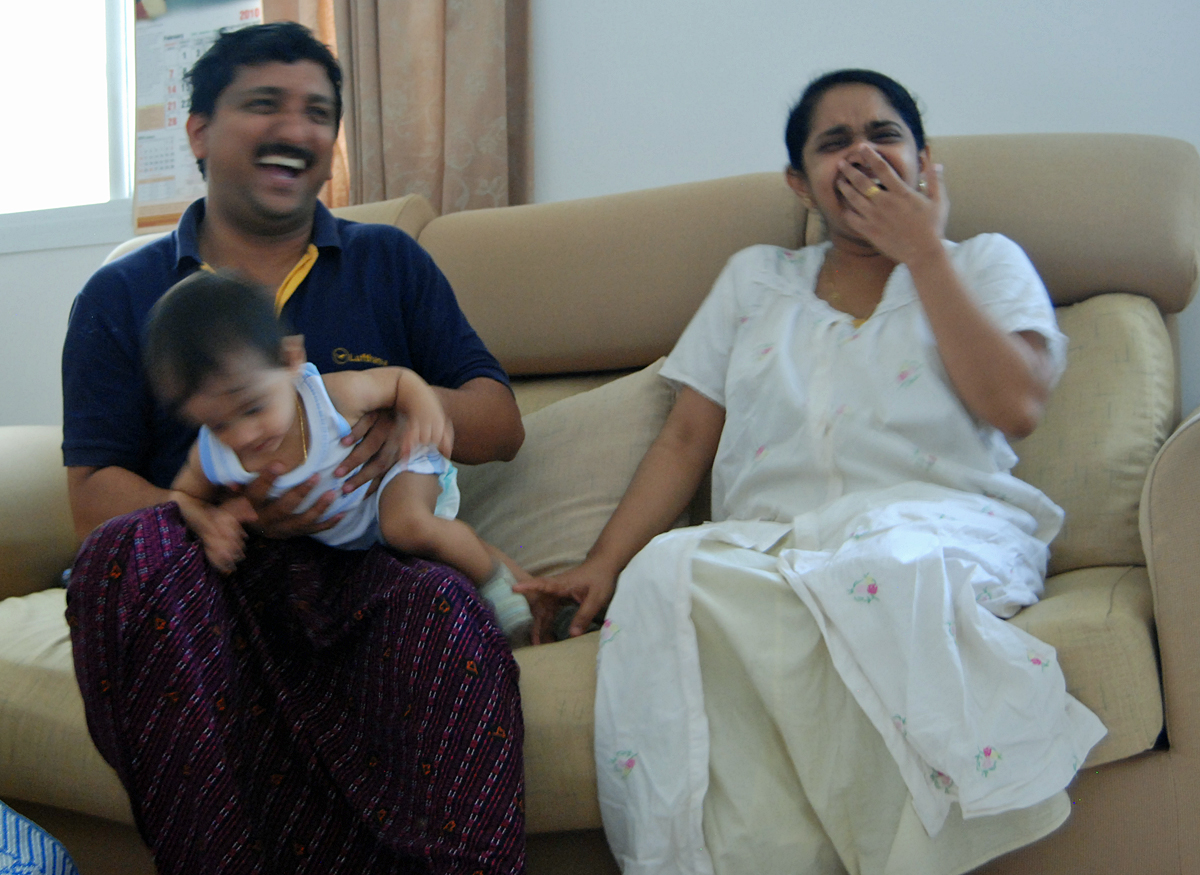
Bainu with his wife Sharol and ten months old son having a break and a laugh.

Bainu with his wife Sharol and ten months old son having a break and a laugh

Back in Oman, right now in the Indian enclave of Wattaya. There´s a smell of curry over the area, but it is calm and sparsely populated. We are staying with two friends, Bainu and his wife Sharol.

“We are worried. We have left everything behind in India and we have given our hearts to Oman” , Bainu Tomas said whilst we were eating breakfast together in his flat in Wattaya, “But this omanization just puts us in a limbo, not knowing what to do or expect. We accept it, but it is still kind of a shock that it will be implemented so fast. That is why my my wife is still working as a teacher, even though with a newly born child, we would need her at home here.”

Bainu came 6 years ago from the state of Kerala, like many other Indian immigrants working in Oman, on an invitation from the government. Oman needed foreign workers to be able to construct a foundation of a country. Just like their neighbors in Saudi-Arabia, Abu Dhabi and Dubai. In Dubai two-thirds of its population is made up by immigrants who are there to keep the country alive. In Oman they´re less, but the country still needs them. But Sultan Qaboos, the beloved ruler, wants Omanis in every position of the society, something I can understand, since I often wonder, what will happen if the poorly treated immigrants in Dubai would revolt against their masters? There is no doubt, that Oman is understanding the issue of keeping its Arab soul better than some of its neighbors. But, the question is, are they ready to run the country by themselves?

Muttrah by night - climate this time of the year is fantastic!

Muttrah by night - climate this time of the year is fantastic!

Since being involved myself in the tourist industry I have seen there´s still a lot of work and acclimatization before Oman can be run by its own people, because the service level amongst them is still low and prices heavily over flated. They still need their ex-pats and immigrants from all over the world. And being a traveller, one always feels like an immigrant, an outsider, so I do well understand them and nothing upsets me like the stories that come out from for example Dubai how badly treated some of the immigrants from Pakistan, Bangladesh and India are. But Bainu has been happy during his time here.

“Well, I belong to the educated immigrants who come here, not the laborers, and for this reason life has been good” , he said and smiled as always.

Bainu is religious and spends a fair amount of time in his local church all made up of Indians from Kerala, and he is therefore very easy going and gentle, and doesn´t judge anyone unfairly or complain about his own situation. But he does says he worries. He isn´t ready to return to India yet. Wages are not on the same level there. And he says that when they first came here, they could even save money and send back, but nowadays, even they almost work 6 days a week, long hours, both of them, they just about make it. But they´re doing well, the Tomas Family, there are other immigrants who are suffering. Please read this article about the situation in Dubai. Oman is different. And it feels good being back!

Abdullah - the driver which quit his job for the day to take us on a tour of Muttrah!

Abdullah - the driver which quit his job for the day to take us on a tour of Muttrah!

Since we stayed outside the more well to do parts of the time, we decided to take the small minibuses to travel around Muscat, when our friends didn´t come and pick us up, and this is really the way to see another, much more interesting part of Muscat and Oman. It is lively, demanding and you get a perspective how things are if you are not well to do in Oman. Everything takes more time and is more demanding. But you meet a lot of great people. One of them was Abdullah, who owns his own mini-taxi and when we met him and said we loved his country, who quit is job and instead took us on a tour of the city. We arrived back at our flat at 2 a.m. People are extraordinary friendly here.

But the reason we have come here this time is two very important lectures which will define the direction of the Expedition. Hold on, you will know in a few days…..this is the most important of all visits i have done to Oman. Judgement day.

Dark clouds and Blue Zones, time to reflect

January 21st, 2010 mikael 1 comment

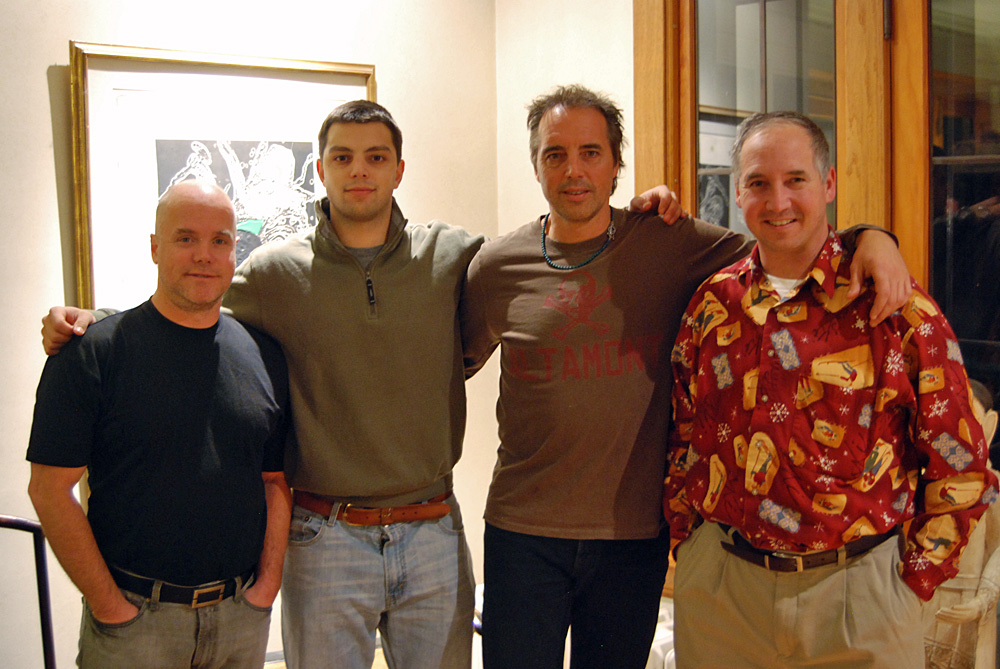
Finally meeting Dan Buettner after being in contact for 23 years in his spectacular mansion in Minneapolis. From left: Me (yes, adding on Expedition weight), Dan Jr, Dan and his brother Steve.

Finally meeting Dan Buettner after being in contact for 23 years in his spectacular mansion in Minneapolis. From left: Me (yes, adding on Expedition weight), Dan Jr, Dan and his brother Steve.

23 years ago I met three Americans on a bicycle in Costa Rica. I remember us putting up camp outside a farm and how impressed I was over their equipment which was so much better than mine. I had a 3-speed bike, an old, leaky tent and a thin foam pad to sleep on. They had cycling helmets, which I thought was hilarious, Therm-A-Rests, new modern tents and 18 speed bikes. It was kind of the old World meeting the New. They were heading down to Argentina and came from Alaska. I was going the other way. They were going to do all of it in 10 months, for which I used 1½ year. The group leader wasn´t here, neither his brother. The team leader, Dan Buettner had flown to Cordoba in Spain to meet his first child, a son, arrive in daylight. His brother Steve was waiting in Managua. Since this day I have been in contact with Dan on and off over the years, since he has cycled through Africa, Russia and much more. But it took us 23 years to meet and that at his son, Dan Jrs, 23rd birthday!

In these years Dan has become very successful. He writes for the National Geographic and his latest book The Blue Zones has been a huge success, sold in 250 000 copies and he has been part of all the big talk shows like Oprah Winfrey and more and after reading his book, which I enjoyed a lot, I have realized, once again, that all seems to be meant, maybe, like the Arabs say, it is written in the stars. It was meant to be, him and me meeting. He gave me a nice perspective on certain things regarding the meaning of life. Dan seemed to enjoy every aspect of life, especially having time to be with his extended family. One of the ten commandments of how to get over 100 years old according to Dan and his Blue Zone project!

Visiting the great area where Dan had his mansion, also offered some nice winter days with son and less cold....

Visiting the great area where Dan had his mansion, also offered some nice winter days with son and less cold....

It was great meeting Dan during the Minneapolis visit. Otherwise a lot of my energy has been trying to figure out how the latest developments in Yemen will affect the Expedition. As it is now, the border between Saudi Arabia and Yemen is closed and I communicate excessively with my friends in this great country. Latest news comes from Brid Beeler, who is more updated than most people regarding the situation in Yemen, that not even the UN are getting through. So far, one of the better articles I have read about the situation comes from The Guardians Brian Whittaker here! This is of course, bad news, very bad news, so the question is, when will the border open up again? And do we need to re-route completely? That means we need more money and more time, which is not easy to acquire in these days of recession. Right now, the situation looks worse than ever and my big worry, is that it will develop even worse, that outside troops will move in and we will have a very serious situation. It smells Afghanistan and Somalia. And all borders will, of course, then be closed to Saudi-Arabia, the country the Expedition really needs and wants to pass through. Not possible, no Expedition. That is reality. We are returning to Oman at the end of the month to continue our work to put the Expedition on its feet. Until than, there are other worries….

And if I haven´t felt the global recession anything earlier, it is moving in everywhere. I get emails from colleagues all over the world who describes the situation more dire than ever. And it easy to see here in the US of A. The recession. It has, so far, been a very important and interesting visit, and the positive aspects of this great country is the multi-cultural society and the positive attitude of most people. I am in Philadelphia right now, and I really like its Afro-American population. On the negative side, this is not a place to be, the US, if things turn bad. No matter how often I have seen homeless people all over the world, it pains to see. I have taken one decision, if I ever, in shallah, become a father, Sweden is the place to be. I have re-evaluated my own country a lot during these last 6 months. I am beginning to feel full proud Swedish again. Especially after meeting all Americans with Swedish back ground in Minneapolis talking about the Old country.

William Penn´s beautiful City Hall in Philadelphia, a very interesting and livly East coast city.

William Penn´s beautiful City Hall in Philadelphia, a very interesting and livly East coast city.

By the way, if you have time to kill, why not come to see the Siberian lecture at Williams College in Williamstown on Friday? See http://www.facebook.com/event.php?eid=260366986429&index=1

GUEST WRITER 3: Tricia Nellesen

January 15th, 2010 mikael 1 comment

My third guest writer is Tricia Nellesen who I met at Sabris school in Sanaa, Yemen, half a year ago and she had an insight to a world which i never will get access to, the one of Yemeni women! Tricia is a reputed cultural anthropologist specializing in Yemen and the Middle East. And after working 11 years as a journalist in the U.S., she returned to graduate school for her PhD.  She became interested in studying Yemen after traveling there for language training and have since her first visit, studied the Middle East for four years and Yemen for two.  And whilst in Yemen, she learned of the water shortage and wanted to help the people in some way—so she stayed in order to learn more.  She is currently in the U.S. writing and compiling her research.

Eyes That Speak:  Lifting the Veil of Yemen

By Tricia Nellessen

Lifting the veil of Yemen....

Lifting the veil of Yemen....

The day after Christmas 2009, I was surprised to find dozens of messages on my phone.  How nice, I thought.  People know that I’m home in the U.S. for Christmas.  I’d been away for many months, and I had not yet turned on the television.  I went about my daily routine intending to listen to the messages later.  I sat down in front of the TV and switched on CNN.  Suddenly all of the calls made sense.  Yemen was being discussed on every channel.  One, lone Nigerian man now had my country of temporary residence in the news because he had traveled to Yemen and then attempted to blow up an airliner.

Since then, everyone has become an expert on Yemen.  I watch the news and smile as I imagine producers scurrying to find video footage that will capture the essence of the nation.  Usually this includes the ever-exotic photo of a fully veiled woman with only her eyes peering out from behind the black cloth.  As the images flash across the screen, journalists constantly stumble over names while interviewing experts who seem to have gotten much of their information from Wikipedia.  The facts are basic.  Yemen is the poorest country in the Middle East.  It sits south of Saudi Arabia and has the highest percentage of detainees from any nation housed in Guantanamo Bay.  The gender roles are strictly segregated, and women veil their faces in public.  Al Qaeda is growing in the region.  Oh yes, and Osama Bin Laden’s father was from an area called Hadramawt (which somehow seems to be pronounced Had-ra-mat, as if it were a laundry, on the news).  These are the facts that keep being repeated.  These are the basics, not the humanity.

I was first introduced to Yemen a couple of years ago at 2am after a number of long flights.  I was a thirty-two year old American woman traveling alone.  After years as a journalist, I had returned to graduate school for my doctorate in anthropology.  Yemen was to be my field site and a perfect place for further language training.  As I stepped from the plane, I took a deep breath and wondered what to expect.  I climbed down the steep stairs from the 747 to the tarmac and walked across the pavement through the glass doors lined by soldiers with rifles slung over their shoulders.  The majority of travelers were Yemenis coming home from trips abroad and my exhausted brain tried to comprehend the foreign words I heard.  As I went through customs, the man sitting behind the desk smiled as I spoke to him in Arabic.  “You are here to study?” He asked.  “Yes”, I replied.  “Welcome to Yemen,” he stated in perfect English as he smiled and handed my passport back to me.  I walked through the next set of doors and into what would become one of the favorite times in my life.

Tricia with a young Yemeni girl. One of many fantastic Yemenis she continually comes across and falls in love with.

Tricia with a young Yemeni girl. One of many fantastic Yemenis she continually comes across and falls in love with.

When I’m asked about Yemen, I struggle to explain the spirit of the people.  How do I say that I wore a burqa because I chose to?  No one would ever think of forcing me to do that there.  How do I explain that Hadramawt is a beautiful, historic area with a library filled with ancient documents and some of the world’s best honey and dates?  How can I explain to those that have never been there that not everyone identifies themselves as Al-Qaeda, and in actuality Yemen is a nation living in poverty and simply struggling to survive.  I’ve traveled around the country and lived with the people, and the only way that I can tell you about Yemen is to tell you of my friends.

I met Noor at a women’s party.  These afternoons lasted for hours and were filled with music, dancing, and lots of conversation.  We would take our black robes and veils off as soon as we entered the house.  Then, the women would drink tea and eat different types of cookies.  It was during one of these parties that I met Noor.  She was a petite woman close to my age.  She smiled sweetly and offered me a seat next to her on the long pillows lying on the floor around a rug in the middle filled with tin trays of food.  Noor only spoke Yemeni Arabic, and we struggled to communicate between her dialect and my American accent.  Still, we became friends.  Once the food was cleared and the music began, Noor pulled me to the middle of the rug.  She was the first woman in Yemen to teach me belly dancing.  We danced for hours and everyone tried to help my American hips learn the foreign rhythms as we laughed the evening away.

After many such gatherings, I finally learned Noor’s story.  We sat drinking sweet Yemeni tea as others danced and I asked her about her family.  She said that she had a daughter and her eyes lit with pride.  I was surprised to learn that her daughter was seventeen years old.  She must have seen my look of confusion, because she quickly explained.  Noor had come from a poor village far outside the city.  Her father arranged her marriage to a neighbor when she was eleven, and a few years later she gave birth to her daughter.  I sipped my sweet tea and digested this information.  I asked her delicately about her husband.  “He’s dead” was the quick reply.  Noor’s face hardened and I knew that the conversation was over.  Months later she told me that he was fifty years old when they were married.  A few years ago, he passed on.  Noor retained his wealth and now remains single.  She is proud and intelligent and amazingly independent.  She moved her family to the capital city of Sana’a and her daughter attends the university there.  Noor even hinted that she might remarry in the future, but this time it would be a man of her choosing.

The window of Yemen, Tricia looking out at life outside her room...

The window of Yemen, Tricia looking out at life outside her room...

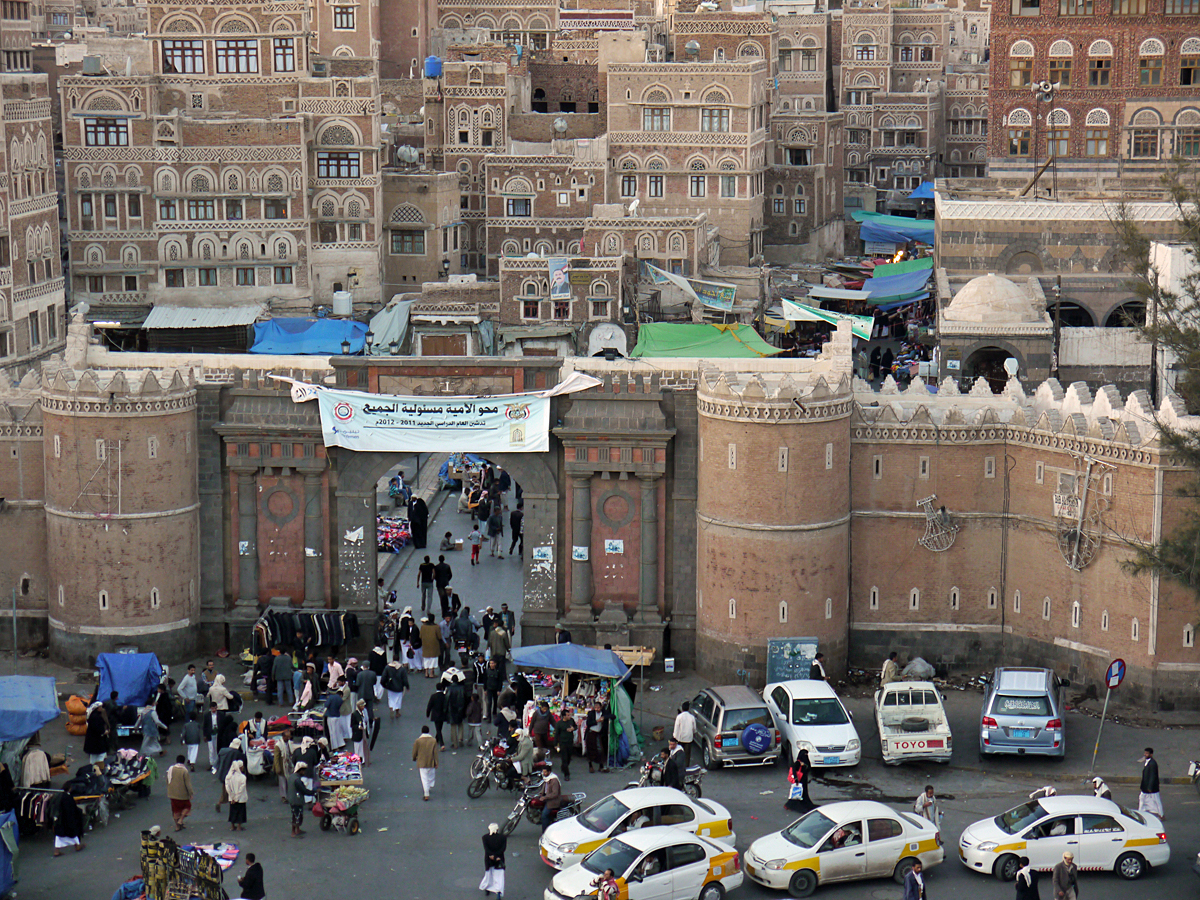
The capital city of Sana’a which hosts the university is a fascinating mix of old and new.  I love walking the streets past the ancient walls of Bab Al-Yemen.  Bab Al-Yemen literally translates to the “door of Yemen”, and indeed it once was truly this.  Two gigantic wooden doors rest eternally open in the middle of a tall stone wall.  The wall used to encompass the entire city of Sana’a, but now it only contains what is lovingly referred to as the Old City.  I have wandered Bab Al-Yemen for hours.  Sometimes I’ve worn the abaya (black robe) and niqab (face veil), and sometimes not.  It really depends on whether or not I want to be noticed as a foreigner.  When fully veiled, I can blend into the crowd.  Why might I not want to be seen as a foreigner?  It is certainly not out of fear, but rather because of all the shouts of “Welcome to Yemen” and “Hello, how are you?”  If I walk the streets as an American, the children run up and scream “soora, soora?” Soora means photo, and the children always want theirs taken.

On the street where I live in Sana’a, the children from the nearby houses run and play in front of my door.  I live on a side street running perpendicular to a main road.  The children of my neighborhood know me well.  When they are out of school, they play marbles and soccer on the cobblestoned alleyway between our buildings.  Mustafa is twelve and is the oldest.  He is respected by the others because of this, and sometimes brings his three year old baby brother out with him.  Mustafa and his brother were orphaned when their parents were killed in a car accident.  His grandfather is raising the boys on a cab driver’s salary.  Ahmed is ten and always full of spunk, ready to play soccer.  He saves bits of change that he finds and sometimes buys me plastic necklaces.  I wear them and he smiles and tells the other boys that I am his wife.  Nabil is ten as well and shares his fireworks with me whenever they have them.  We toss the little caps on the ground and laugh as they pop.  The children’s laughter and shouts are always present outside my door.

Across the street from my house is a café set into a thick mud brick wall.  Its pink, metal doors beckon you in for kabob (fried meat balls) and fool (bean soup).  Ramsey runs the place and is sits by the door to welcome you.  When water became scarce in the countryside, he moved to the city to earn money for his family.  Ramsey is the father of six.  His wife and children still live on the farm, about four hours away.  He works for a month or more before being able to travel the distance to see them.  He doesn’t own a car, and the business needs him in order to stay open.   I always ask him how his family is, and he’ll pull out his cell phone and show me pictures.

"The capital city of Sana’a which hosts the university is a fascinating mix of old and new.  I love walking the streets past the ancient walls of Bab Al-Yemen."

"The capital city of Sana’a which hosts the university is a fascinating mix of old and new. I love walking the streets past the ancient walls of Bab Al-Yemen."

So, you see, as the exotic images of Yemen appear on television screens across the world, I can only think of my friends.  There are so many other stories that I could tell which would humanize the stark photos being shown across the world of the tiny little country that no one knew of but that now is in all the headlines.  The scenes the news agencies show are from streets that I have walked dozens of times.  As others see only mysteriously veiled women and foreign landscapes, I see my friends and paths full of memories.  It is true that Al-Qaeda exists in Yemen, but it is also true that the majority of people are simply trying to make a living in a country which was forgotten until this Christmas when one man suddenly brought the spotlight of the world to bear.  Yemen has faced Al-Qaeda attacks for years.  It sits on the brink of civil war as the South threatens to secede once again, and rebels to the north of Sana’a continue to fight the government forces.  Amidst all of this, Yemen is projected to become the first country in the world to suffer a complete lack of groundwater as its aquifers drain and the rains move away from the Arabian Peninsula.  Yemen and its people have been, and will continue to be, facing serious challenges.

I sat in Sana’a sipping tea with Michael a few months ago and he asked me what it was like to be a woman living in Yemen.  I remember telling him tales of my friends and experiences.  Michael understood, as explorers do, that societies are complex and varied.  To truly understand a people, one has to delve beneath the obvious and experience the everyday and mundane.  To me, the veil has yet to be lifted from Yemen in the eyes of the world.  Rather, the information coming out of Yemen from the outside media is vague and unsubstantial because of lack of attention in previous years and the newly escalating security situation with Al-Qaeda in the Arabian Peninsula.  It is my hope, as days move forward, that a distinction will be made between the people and the destructive elements driving Yemen towards becoming a failed state.

Tricia can be contacted here!

I am right now Ahmed Al-Hamdani

September 5th, 2009 admin No comments

”My father and his father and so on, they all travelled to Mecca by camel” , the old man explained whilst touching the top of his jambiyya , “It took my father four months to get there and the same amount of time back. In those days you only made the pilgrimage once. It was too difficult and to expensive.”

The old hajji....

The old hajji....

“Isn’t it still expensive to do a pilgrimage to Mecca? My teacher told me yesterday it is still very expensive and for most people, if it is possible at all, that once in a life time is an achievement, a dream.” I said, remembering Rashad telling me that he hoped to do a pilgrimage, but that it would take him many years to save the money needed, “He said it would cost him at least half a million rials (approximately 2500 dollars) to do a proper pilgrimage, since he had to go through a travel agent here in Sana’a specialising in pilgrimage tours to Mecca. About 25 days including hotels, transport, air tickets, a visit to the prophet’s grave in Medina and so on. And he said that the Saudis only allowed a certain amount of pilgrims per country a year.”

The giant mosque built by the president Abdullah Saleh

The giant mosque built by the president Abdullah Saleh

“The Saudis….” , the old hajji said with a grim face, “…charge you for everything including breathing.”

A very good friend of mine, one of few Muslim explorers on earth, a true Ibn Batutta of today, said that he flew from Afghanistan to Mecca to do his first pilgrimage and was treated like shit until he showed his American passport. He wasn’t too fond of the Saudis in Mecca either. I have to say, they don’t seem to have the best reputation in the world, neither among ex pats or other gulf Arabs. Than again I have heard a lot of opposing views. That the Saudis are amongst the friendliest and best people on earth. The idea seems to be to avoid Jeddah, Riyadh and Mecca/Medina. The reason I bring Saudi Arabia up is that it is a country everyone continuously talks about in these parts of the world. In Yemen every day. The Saudis are in many ways very influential and powerful players in the global economy of not only the Gulf, but in the rest of the world as well. I look forward to travelling through Saudi-Arabia a lot!

Inside the mosque which seats 20000 devotees....

Inside the mosque which seats 20000 devotees....

“So you are contemplating to travel by camel?” the old man said more as a statement than a question and than added: “It is the best way to travel! Just treat them well and they will be your best friends forever!”

It was Mohammed, Hussein’s employee and best friend, who had set me up meeting this old man, who’s first name was Abdullah and came from the same village as Mohammed. They had the same second name, Al Mawari. Many people’s second names in the Arab World also tell a visitor the geographical background of a person. And ever since I was given a great gift from my great best friend Pamela, see last report, a zannah (ankle long white robe), a silver belt with an expensive jambiyyah with a Bedu background and a turban or head cloth, sharh,  with a colour and pattern which makes locals sometimes call me Palestinian, I have honorary been given the name Ahmed Al-Hamdani. Basically due to the way Hussein made up my turban, just like a Bedu from the Hamdani region. Even Abdullah called me a Hamdani, even though Mohammed had to translate. I have to say I still somewhat surprised how honoured and happy the locals are when you are dressed like them. This I have never seen anywhere else, well, maybe Oman.

Hussein, Ahmed Al-Hamdani and Mohammed outside the presidents mosque...

Hussein, Ahmed Al-Hamdani and Mohammed outside the presidents mosque...

“So you stopped using and working with camels as long back as 30 years ago, what do you miss the most regarding these fantastic animals and do you have any advice to me to bring on my journey?” I asked him, because I had earlier asked Hussein if he could find a Yemeni who had travelled to Mecca by camel and could tell me which route they had taken, since I would like to stick to the traditional pilgrimage route from Sana’a to Mecca.

“I used to travel from Sana’a to Al Hudaydah (link to Yemeni map) on the west coast, and back, bringing food for people and animal, it used to take eight days and we travelled 16 hours per day”, he recounted with passion, “And what do I miss? I miss the freedom and the evenings in front of the fire. And I miss the camels. If you treat them with love, you will always have a loyal friend.”

Praying at the mosque....

Praying at the mosque....

“Which route did your dad take to Mecca?” I asked again, because our conversation was on and off disturbed by other locals in the room teasing and laughing at the old man, just because he used to work camels and right now was a quite hard line Muslim belonging to the Shia arm of Islam. All others Yemenis in the room were Sunni. The war in the north, between the government and the Al Houthi could in some ways be called a religious one. A war between Sunni (government) and Shia (al Houthi).

The "birthday" cake from my friends....the inscription reads Mikael - the sheikh of the Bedu

The "birthday" cake from my friends....the inscription reads Mikael - the sheikh of the Bedu

“Quiet!” he hissed at his teasers, who laughed back and teased him a bit more, but he continued: “Well, the pilgrims and hajjis to be, always set out from Saada and from there travelled to Mecca via Baqim, Zahran, Haraja, Khamis Mushayt, Abha and down to the Saudi coast and from there on to Jeddah and Mecca.”

Amazingly enough exactly the route I had planned just by looking at the map geographically 3 months back and searching for the existence of valleys, plains, paths and roads. However, my Expedition is still far off in time, in shallah, if all goes well, we will set off in January next year, but, this fact apart, yesterday I was also given an especially made cake by Pamela, Hussein and Mohammed, thick and tasty and its chocolate decorated with a white camel and the words:

“Mikael – the sheikh of the Bedu”.

After the party we went to the souk after midnight to eat some kebabs at this place....

After the party we went to the souk after midnight to eat some kebabs at this place....

People here in Yemen, my friends, are the best of the best. Warm, generous, funny, smart and they all love life. I still don’t know what we were celebrating, but it filled me with great joy! On top of that I was given a full Sanaani outfit including the most macho of all male symbols in Sanaa, a jambiyya, and together with Pamela, Hussein and Mohammed we took a taxi –this was another “birthday” surprise organised by Pamela for me- and we ended up at the spectacular Presidents Mosque. Its main hall is so big so that it can seat 20 000 devotees facing Mecca in prayer! We weren’t the only foreigners there, me, Ahmed Al Hamdani, and Pam dressed as a Sanaani woman, then named Pamela Al-Sanaani to make it easier to get in during prayer. There were many Indonesians and Malaysians amongst the devotees. Security was hard, but Hussein got us through everywhere with his kindness, humour, baton and peculiar ideas. It beats the Sultan Qaboos Mosque in Muscat. It is grander.

“The cost to build this mosque equalled ten hospitals”, Mohammed commented with his down-to-earth wisdom:” I think most people wanted hospitals, but the president wanted to be remembered.”

Hussein, Pamela and Mohammed outside the Presidents Mosque.

Hussein, Pamela and Mohammed outside the Presidents Mosque.

I have also realised that most local people don’t really appreciate the war against the Houthis, which many see as their brethren and fellow Moslems. The war planes are still leaving Sana’a in great numbers. It is still a very unnerving feeling. Thank God for friends like Mohammed, Hussein and Pamela!

A taxi ride to Brid and Richard

July 23rd, 2009 admin No comments

“What I think about the Saudis…” , Kasim said whilst chewing an enormous load of kat , “Hmmm…well, you have to excuse me, but I don´t want to talk bad about other people.Please excuse me.”

Kasim the taxi driver

Kasim the taxi driver

Kasim, the taxi driver, well, his answer was so typical Yemeni. They´re easily among the friendliest people I have ever met, but I think amongst the most amazing thing I have encountered is their attitude not to down talk other people. Now, for me, coming from a continent where we have newspapers like the awful tabloids, sit coms full of people hired to talk crap about others and reality shows like Big Brother where people thrive a bad talking others, Yemen is so refreshing!

We just stopped Kasim outside our living quarters in a tiny alley in the old city of Sanaa, on our way to visit a new friend of mine, a power station of sorts, Brid from Ireland, and it turns out that Kasim speaks pretty much perfect English. Part of his family, which is the case with many Yemeni, are living abroad. He has spent more than five years in Saudi Arabia himself, working and collecting funds for his big family, did well and returned and runs a taxi company amongst other things. And the only negative word I could get out of him, on the way back from Brid and her great husband Richard, was that the Saudis where maybe a bit to strict. Both Richard and Brid had also lived and worked in Saudi Arabia.

However, that half an hour it took us to leave the Old City and make our way through heavy traffic to the new part of time, as many taxi drivers world wide, it turns out Kasim was a wealth of information and full of opinions of his own country. Now, since the country is in some kind of a dire situation, which according to Kasim is similar to Somalia a bunch of years ago, which threw the country into a continues series of internal wars and poverty, Kasim was of the very astute opinion that only words and conversation could solve the growing problems the country are facing. For more info on the situation, see local opinion from Yemen Times and on the international side, see BBC.

muruur_26_september_shaarIt wasn´t easy to find our way to Brid and Richard, but Kasim took it as a quest of life and eventually we ended up on the carpet in their home eating and drinking and discussing Yemen.

“Why we choose to move to Yemen instead of Oman? Well, the thing is that Oman isn´t much different to the West. You have to put in 80 hours a week to survive and the demand is as hard and we have had enough of that. But, as important is, Oman is becoming more like Dubai and the West and moving away from the real Arabia. And after years in the Arab world, we want to stay close to the true soul of Arabia.”

Richard and Brid

Richard and Brid

It was actually this Irish powerhouse who persuaded me to come to Yemen instead of Damascus or Cairo and I don´t regret that for a second. Even though I have only been here two weeks, it is a high light of my life. And I remember something a good friend of mine said, he´s living in Oman, a Brit, Marc, when we were discussing foreigners (expats) living abroad and in the Gulf area, why it is such a major difference between the quality of the expats. I have personally found the best, friendliest and funniest expats in the most difficult and demanding of countries and the truth is probably as Mark said:

“You go to Saudi to make money, but you choose to work and live in Oman, Yemen and Kenya because you want to live there.”

For me, a personality will always be preferred to a copy of the rest of us humans, because when you meet personalities not only do you have a good laugh, but you learn enormously much and you leave them with a very positive attitude o life. Just like living Brid and Richard. Who will help me a lot whilst I am here. Great people!