Archive

Posts Tagged ‘congo’

Guest writer # 21, Kennedy Nari – You have to visit Congo!

September 2nd, 2010 mikael No comments

 I come from the Great Lakes Region of Africa, being born in Congo, just 500 metres from the Ugandan and 10 km from the Rwandan borders, providing me with an international perspective from a very early age.  I completed my secondary education in Goma.  Goma is the administrative and business centre of east Congo, nestled on the Rwandan border.

I come from the Great Lakes Region of Africa, being born in Congo, just 500 metres from the Ugandan and 10 km from the Rwandan borders, providing me with an international perspective from a very early age. I completed my secondary education in Goma. Goma is the administrative and business centre of east Congo, nestled on the Rwandan border.

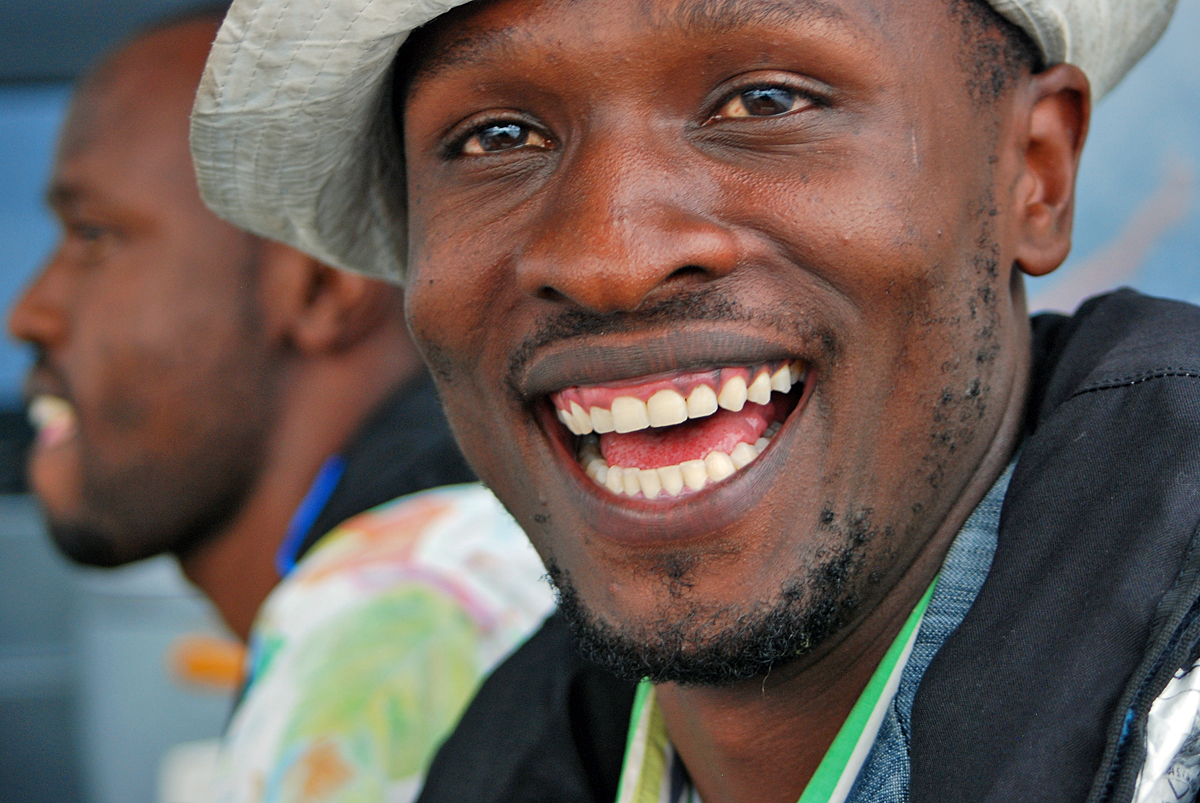
Kennedy Nari is one of these amazing personalities that I have been privileged to come across whilst travelling. I met him during my Congo trip. He is doing a dogs work to promote his fantastic country and for the first time since I started to invite guest writers, I am actually going to give him a chance to do some promotion for himself and his company. He is a great guy. As at home with a Blackberry as how to dance the jambalaya dance. Congo is a spectacular country, for me, the real Africa. Its heart. See this slideshow, before starting to read Kennedy’s ode.

Jambo, habarigani, wazungu? I am Kennedy Nari from Hakuna Matata Tours! Let me first tell you about my beloved country Congo and why you should come here!

Very few people know about travel in this part of the world, but Congo DRC offers tourists many unique opportunities to see wildlife, indigenous cultures, and geological wonders not found easily or anywhere else in Africa. In the DRC, you can trek to see both mountain and lowland gorillas in wild, meet pygmies still practicing their traditional way of life in the forests, spot bonobos and okapi–two rare species not found anywhere else on earth, and climb to the summits of active volcanoes. The DRC has appeared frequently news the past few years because of unrest in the eastern past of the country, but thankfully the region has come to enjoy peace over the past year, and tourists from overseas have been coming in growing numbers to enjoy its attractions.

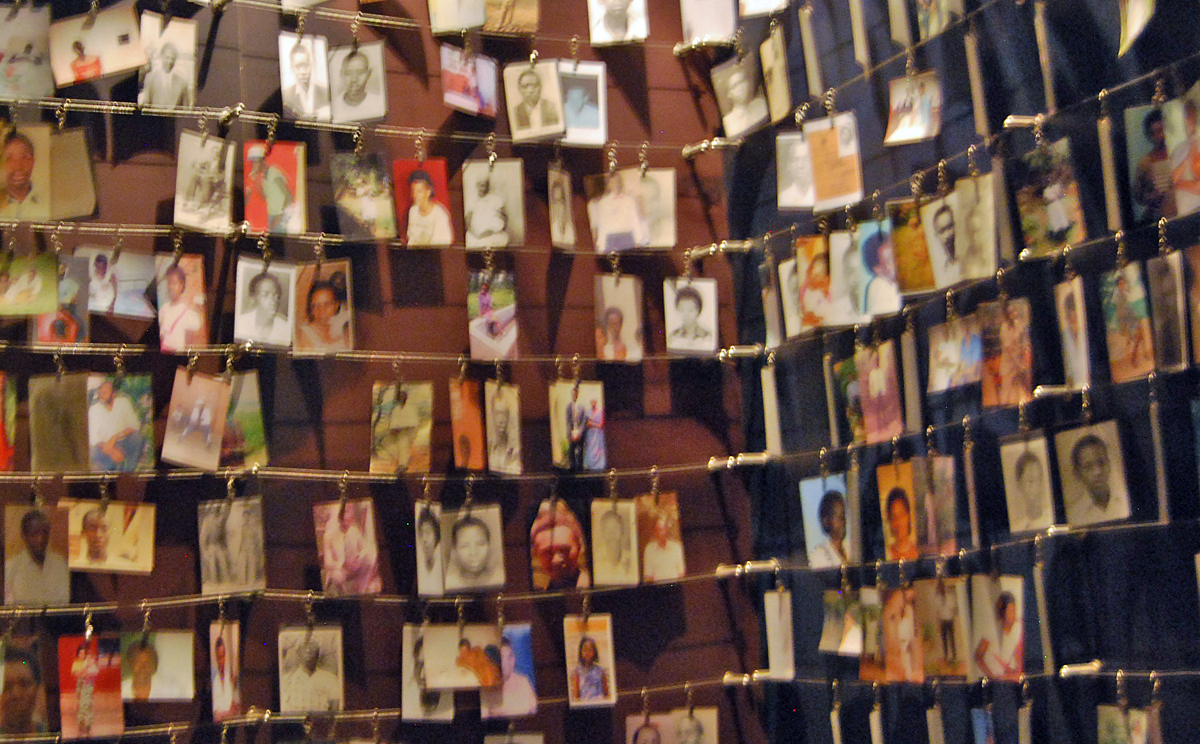
Mikael used our company when he recently visited Congo for his second time, I traveled with him from Rwanda, where we visited The Genocide Memorial and Nyungwe Forest, then we crossed the border to Congo Drc, where we visited the Low land Gorillas in Kahuzi Biega, Pygmies, Bonobo, Nyiragongo Volcano and the Congo river, we spent 2 weeks with Mikael together with Jeff “Bazooka” Willner, the boss of Kensigtotours.com, the number  1 adventure tour company in the world.

Kahuzi-Biega National Park is probably the least visited gorilla habitats in the world. It is, of course, due to that it is place in what is globally seen as a volatile region of Congo and the world. For this reason, there’s very few tourists, it’s unspoilt and feels very fres

Kahuzi-Biega National Park is probably the least visited gorilla habitats in the world. It is, of course, due to that it is place in what is globally seen as a volatile region of Congo and the world. For this reason, there’s very few tourists, it’s unspoilt and feels very fres

Mikael is the nicest guy I have ever met, funny he can make you laugh at any time. Mikael can help you reduce the level of stress hormones like cortisol, epinephrine (adrenaline), dopamine and growth hormone. He can help you  increases the level of health-enhancing hormones like endorphins, and neurotransmitters for free, just by making you laugh. Yes because laughter increases the number of antibody-producing cells and enhances the effectiveness of T cells. All this means a stronger immune system, as well as fewer physical effects of stress. For all the 2 weeks I spent with Mikael I benefited from all the remedies from him, for free.

Together with Mikael visiting the pygmies in Epulu.

Together with Mikael visiting the pygmies in Epulu.

I think he would agree that Hakuna Matata Tours is a successful, and reputable safari and tour company operated by me and my wife Desange, employing a team of professional local tour guides across the region. One is the famous fly catcher and extra ordinary story teller Emmanuel Joseph Munganga.  I come from the Great Lakes Region of Africa, being born in Congo, just 500 metres from the Ugandan and 10 km from the Rwandan borders, providing me with an international perspective from a very early age.  I completed my secondary education in Goma.  Goma is the administrative and business centre of east Congo, nestled on the Rwandan border.  Here, I benefited from further cultural exchanges, forging yet more international community ties, this time with Rwanda, adding to my sense of being an international citizen while gaining the prized Diploma in Accountancy and Finance. I then moved to Kenya to spend two intensive years studying English, returning to Congo in 2003 as peace began to flourish.

A growing number of adventure tourists began arriving in Goma hoping to explore the wildlife especially within Virunga National park and the stunning landscapes around and on Nyiragongo Volcano.  I became a well-known guide and translator, one of the few with fluent English in addition to Lingala, Swahili, Kinyarwanda and French.

Our company, Hakuna Matata Tours, is the most well established tour company in eastern Congo, having offered DRC tours since 2004. We are a Congolese owned and operated company based in Goma on beautiful Lake Kivu and we know the country better than any other travel operator. Congo need tourists to be able to develop and become a stable country again. Please come! AND, please see Innocent Balunde, my friend, who won the Congolese Idol competition!

Explorer Mikael Strandberg to support launch of Kensington’s new Expedition Series

July 12th, 2010 mikael 1 comment

PRESS RELEASE!

WORLD FAMOUS EXPLORER JOINS KENSINGTON TOURS
AS EXPLORER-IN-RESIDENCE

Mikael Strandberg to support launch of Kensington’s new Expedition Series

“Kensington Tours' mission,” says Willner “is to provide private guided experiences to every corner of our world. For every budget, every schedule, every group size, and every interest, we can tailor a perfect tour. Our collaboration with Mikael and our Explorer-in-Residence program is another example of our commitment to truly special travel experiences – whatever your travel style.”

“Kensington Tours' mission,” says Willner “is to provide private guided experiences to every corner of our world. For every budget, every schedule, every group size, and every interest, we can tailor a perfect tour. Our collaboration with Mikael and our Explorer-in-Residence program is another example of our commitment to truly special travel experiences – whatever your travel style.”

A professional explorer for the past quarter century, Mikael Strandberg is considered one of the 50 most important explorers on earth and The Explorers Club has called him “the best contemporary explorer in the world.” Strandberg will collaborate with Kensington founder and CEO Jeff Willner to design and develop this new product offering for intrepid travelers.  Strandberg will also be available to guide these expeditions as well as tailor-made expeditions, upon request.

“Kensington Tours’ mission,” says Willner “is to provide private guided experiences to every corner of our world. For every budget, every schedule, every group size, and every interest, we can tailor a perfect tour. Our collaboration with Mikael and our Explorer-in-Residence program is another example of our commitment to truly special travel experiences – whatever your travel style.”

Willner and Strandberg recently undertook a scouting mission to The Democratic Republic of the Congo to assess its potential and readiness as a destination for intrepid travelers.  Congo itineraries – featuring endangered Eastern Lowland Gorillas, Pygmy tribes and the Nyiragongo volcano – are the first in the Expedition Series.  Other itineraries under development include Antarctica exploration with polar explorers, motorcycle safaris in Kenya, Tanzania and Russia, deep dive submarine into the Cayman Trench and cultural discoveries in Yemen, Oman and North Korea. These itineraries will appeal to intrepid global explorers and will complement Kensington’s complete collection of affordable private guided tours to the world’s must-see destinations.

“It’s the places that people believe that they cannot go, these are the places where the hidden wonders of the world and breathtaking experiences await,” said Strandberg. “The Expedition Series will highlight many of these destinations.  I am indeed honored to be an Explorer-in-Residence for this brave company. Brave makes a difference, helps a country, builds bridges and creates trips which open people’s minds. With a visionary and a lover of humanity like Jeff Willner at its helm, Kensington Tours is really in the forefront of what good tourism should be today.”

“Some of the Expedition itineraries may require hard work, some may be expensive and some will feature unconventional destinations, but all promise a unique experience,” confirms Willner.  “Whether escorted by an Explorer-in-Residence or not, all of our tours will be carefully managed by our local offices and local expert guides to ensure a safe and supported adventure.”

####

“It’s the places that people believe that they cannot go, these are the places where the hidden wonders of the world and breathtaking experiences await,” said Strandberg. “The Expedition Series will highlight many of these destinations.  I am indeed honored to be an Explorer-in-Residence for this brave company. Brave makes a difference, helps a country, builds bridges and creates trips which open people’s minds. With a visionary and a lover of humanity like Jeff Willner at its helm, Kensington Tours is really in the forefront of what good tourism should be today.”

“It’s the places that people believe that they cannot go, these are the places where the hidden wonders of the world and breathtaking experiences await,” said Strandberg. “The Expedition Series will highlight many of these destinations. I am indeed honored to be an Explorer-in-Residence for this brave company. Brave makes a difference, helps a country, builds bridges and creates trips which open people’s minds. With a visionary and a lover of humanity like Jeff Willner at its helm, Kensington Tours is really in the forefront of what good tourism should be today.”

About Kensington Tours
Kensington Tours offers custom private guided tours to over 80 countries around the world. The flexibility of Kensington’s offerings allows for personalization of every tour at a wide range of price points – resulting in a handcrafted vacation experience at an unbeatable value. The company’s private tours are regularly benchmarked at 30% less than identical tours from premium group operators. Kensington Tours was named one of the ‘Best Adventure Travel Companies on Earth’ in 2008 & 2009 by the editors of National Geographic Adventure magazine.

About Mikael Standberg:
He started his professional career as an explorer 23 years ago. Strandberg is currently working as an explorer, a lecturer and a writer. He has also produced three internationally renowned documentaries for television Patagonia – 3,000 Kilometres by Horse and The Masaai People – 1,000 Kilometres by Foot and his much awarded 58 Degrees – Exploring Siberia on Skies.  Frequently appearing in travel and adventure programmes, Swedish Television SVT and National Geographic have both made documentaries about his life. Voted Explorer Hero by the National Geographic 2002, Strandberg is an Honorary Ambassador of his native district Älvdalen and Cappadocia, Turkey. In 2005 he was awarded The Determination in the Face of Adversity Medal by the Explorers Club. The Travellers Club of Sweden awarded him the prestigious Silver Medal in 2006. The Travellers Club of Finland awarded Mikael the prestigious Mannerheim Medal at a ceremony in October, 2006.

About Jeff Willner
Kensington Tours is the inspiration of intrepid explorer and Royal Geographic Society Fellow Jeff Willner begin_of_the_skype_highlightingend_of_the_skype_highlighting. His thirst for travel stems from growing up in Africa where his parents worked for most of his childhood, and where he discovered the richness of global cultures. A veteran of global expeditions to over 70 countries, he has criss-crossed the continents to experience the extraordinary. During these years, Jeff realized the vast difference between a package tour and personal discovery — where deep knowledge and personal attention of a local guide can turn a trip into an experience. It is from these roots that Jeff began building his vision for Kensington Tours. With a commitment to rethinking the way we travel, and drawing on his years with McKinsey & Company and Wharton, he recruited a strong team of destination experts (with real in-country experience) and top IT professionals to build an award winning travel company that now spans the globe.

For more information please contact:
Jeff Willner
CEO,
Kensington Tours
jeff.willner@kensingtontours.com

“Some of the Expedition itineraries may require hard work, some may be expensive and some will feature unconventional destinations, but all promise a unique experience,” confirms Willner.  “Whether escorted by an Explorer-in-Residence or not, all of our tours will be carefully managed by our local offices and local expert guides to ensure a safe and supported adventure.”

“Some of the Expedition itineraries may require hard work, some may be expensive and some will feature unconventional destinations, but all promise a unique experience,” confirms Willner. “Whether escorted by an Explorer-in-Residence or not, all of our tours will be carefully managed by our local offices and local expert guides to ensure a safe and supported adventure.”

Nutrition on Expedition

June 22nd, 2010 mikael 3 comments
I added on plenty of fat before setting out to walk against Maasailand....fat is good!..

I added on plenty of fat before setting out to walk against Maasailand....fat is good!..

My friend Nick Gallop, who has written one of my guest writer columns, sent me an interesting query about nutrition on Expeditions. It is a very interesting question, what to eat on an Expedition! So I decided to use his great questions for another blog report!

1. On long, man-powered expeditions like yours what problems do you have getting enough calories and nutrition?

Well, most of the time, there´s just not enough food around! And one can´t haul enough……Therefore, one just have to eat a lot of fat, loads of caloeries and hope that one comes a cross some kind of civilisation every month to be able to fill up with the best possible foods! There´s no doubt about it, that you do take a good beating on long, man hauled Expeditions!

2. What food tips do you have for anyone planning such an expedition?

One just have to add on a few extra kilos before leaving, maybe not 26, like I did before the Siberian Expedition! But quite a few, yes! Because you will loose lots of kilos!

Most of the time, one is really, really tired, so there´s little energy to either fish or hunt or do any complicated meals, so bring lots of freeze dried food, but with some tasty food 1-2 a week. Like dried moose fillet…..I recommend REAL when it comes to freeze dried food. Tasty and filling!

3. It seems to me that people eat some real crap because it’s light to carry and find it too easy to skimp on nutritional content. How can we find the right balance?

Well, REAL is quite good, actually, but on top of that, eat everything you can get your hands on!

Nalim is probably the best fish to make stroganina out of!

Nalim is probably the best fish to make stroganina out of!

4. What’s your favorite expedition food?

Dried moose heart. Dried fish. Like straganina! Yummy!

5. The kit list for your 2004-2005 expedition along the Kolyma river in Siberia included the following items:

Fishing and hunting equipment

• 1 Rifle, Blaser R90 Off-Road with .3006-pipe [barrel]

• Telescopic sight

• Extra ammunition holders

• 1 Cleaning kit

• 2 Fishing rods

• 60 bullets, lead .3006

• A Couple of baits and wobblers

• Extra line, flys, casting balls

• Float, hooks

• Landing net

• Fishing net

Being Swedish, I’d guess that hunting and fishing is very natural to you but many people in the UK probably wouldn’t consider taking this kind of hardware – especially a firearm. How did carrying it change the expedition?

Lot´s of fresh, nutritious food!

The Siberian hares were not only big, but really tasty and nutritious!

The Siberian hares were not only big, but really tasty and nutritious!

6. What problems did carrying a firearm cause you?

In Siberia, on and off, they, the authorities, thought we were hired guns, mercenaries or/and snipers!

7. When planning the expedition did you have a rough idea how much food you could get by hunting and fishing? Were your ideas right?

No, much more difficult than I thought! A typhoon moved in the second day, we didn´t get anything for the first month!

8. Was the time for food gathering included in your plans? – how did the sometimes time-consuming task of finding food fit in with the objectives of the expedition?

We only fished and hunted before the arrival of winter. Hunting and fishing is also part of who we are, so it is a fulfilling work!

9. It’s very easy to pack some simple, lightweight fishing kit and simple hunting kit such as a slingshot. Do you think the time invested in learning to use these effectively will be worth it?

No, hunting should be efficient and the game shouldn´t be suffering unnecessarily. Always shoot to kill the easiest way, e.g the heart. Fishing, sure, but it is harder. Better to bring a net…..

You need a good knife to be able to eat stroganina!

You need a good knife to be able to eat stroganina!

10. If you could carry one packable hunting or fishing item on expedition what would it be and why?

Knife! Well, it is the most vital item. You can do pretty much everything with it!

11. You’ve done some very long cycle expeditions – how different was the food situation on these?

Well, you can carry more food and roads are most of the time close to settlements where u can fill up!

12. As you know I’m very interested in the connections we can make with indigenous people through the use of primitive skills. If we learned about wild food and hunted, fished and foraged on our expedition how would it change our relationship to the people we meet along the way?

Good question! It would make a dramatic difference, since getting to know local people, indigenous or not, you need to have some very close things to associate with to open the door to their hearts, hunting and fishing is part of their lives!

13. How do you think our expedition food choices affect the environment?

Depends where…….In Siberia, hunting and fishing in a proper way, doesn´t harm, but otherwise, if you by local food, this is of course, helping the local economy. So buy locally! If possible….

The food amongst the maasai wasn´t always easy to digest.....

The food amongst the maasai wasn´t always easy to digest.....

14. What’s the worst thing you’re ever had to eat on an expedition?

Well, drinking raw blood with the maasai wasn´t a hit, I can tell you that! Basically due to the heat and other surrounding smells…..like urin…..and also, am now fan of tree slugs in Congo! And my friend Dogan Tlilic´s iskembe soup, am not big on tripe in soups!

15. Have your food experiences while on expedition changed your thinking on how we treat food back in Europe?

Well, being brought up in the countryside and forest, hunting and fishing has been a big part of my life. So Siberia taught me to take care of every single part of the animal, including the muzzle of a moose and their brains…..yummy!

The Arabian Expedition….

June 15th, 2010 mikael No comments

The Arabian Expedition is still far off. However, it will happen eventually. The Arab world still dominates my thoughts and life in many ways. And, a documentary will be made. Photo courtesy of Anders Åberg Film

The Arabian Expedition is still far off. However, it will happen eventually. The Arab world still dominates my thoughts and life in many ways. And, a documentary will be made. Photo courtesy of Anders Åberg Film

I continue to get loads of emails asking what happened with the Arabian Expedition?

Well, the very good news is that we have one major sponsor in the waiting, but need one more to get it going. And we have a few minor one´s lining up too, but right now, it is on hold. I don´t know for how long. I am still waiting for the go ahead from the major contributor, but so far, he is still pondering. Therefore, I have returned back to Stockholm in Sweden, getting on with my old life. Lecturing, guiding, writing and waiting to see what happens. I do have some extremely interesting projects coming up on both the Exploration front and the lecturing side of life. Today I lectured at TED X in Stockholm and enjoyed their idea of spreading interesting ideas a lot. You can see the lecture LIVE here!

So, right now, it is kind of a Catch 22 situation of my life.  But, it is also an extremely good time of my life. Something I will share with you all in the future. But this is not the right time. But, it is definitely a major piece in the jigsaw of understanding the meaning of life!

I also think about Congo pretty much every day and miss the company of Jeff, Kennedy, Olly, Emmanuel and the smell of Africa.

I have met a lot of great people since I came back to Sweden, my old friend Nima for example. Who knows what will happen if we put our knowledge together?

I have met a lot of great people since I came back to Sweden, my old friend Nima for example. Who knows what will happen if we put our knowledge together?

By the way, I follow Ripley´s slog against himself in Mongolia!  And I am happy to say that Christian Bodegren have returned home after some minor problems on his Sahara trip. He has definitely grown as a human being, which shows that his Expedition was a success!

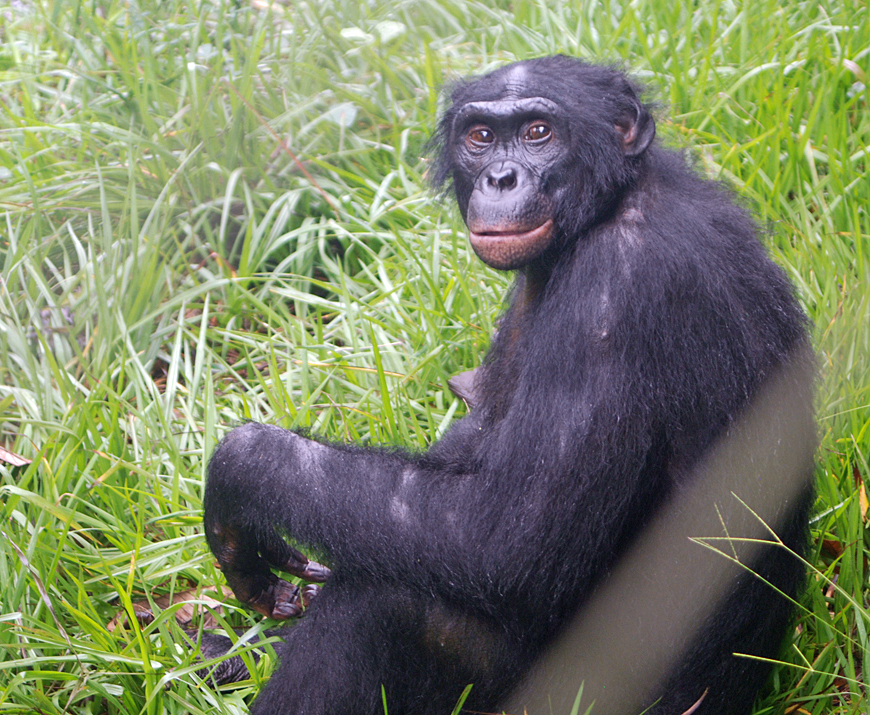
Bonobo – the love monkey

June 4th, 2010 mikael No comments
bonobo_1

Bonobos are capable of passing the mirror-recognition test for self-awareness. They communicate primarily through vocal means, although the meanings of their vocalizations are not currently known.

I first heard about our closest relative, the bonobo, whilst reading a book written by an extra ordinary writer, and a friend, Lasse Berg. If he, instead of being born in Sweden, would have been raised in, for example, the United States of America, he would be a world renowned writer and scientist today. In this book about the origin of human kind, he states that not only is the bonobo our closest relative, but it shows that we instead of becoming such a violent ape, could have copied this dwarf chimpanzee instead of the more aggressive bigger chimpanzee or gorilla. Because, compared to his bigger relatives, the bonobo just makes love to handle any sense of aggression! With anyone. Their kids, same sex, well, anyone around!

“Emmanuel should have seen this!” Kennedy laughed when we sat and watched a group of bonobos eating and lovemaking at the Bonobo Reserve just located outside the capital Kinshasa, “It´s unbelievable!”

Was this our closest relative? Did I feel any connection, like I did when meeting the lowland gorillas? I think even more! It was almost scary! Because when we first arrived to the Reserve, the last stop of this great Tour of Congo, after a slightly traumatic trip by van on terrible roads, we came across a lone male bonobo sitting next to a little pond playing with an empty plastic bottle. Suddenly when he saw us, he stood up and raced up and down the fence, making a noise in the grass with the bottle, which was similar to the one I managed to get as a kid with I taped a piece of cardboard on my bicycle wheel. He ran up and down the fence until one of the local guides we were forced to have from the capital, made an idiot of himself, trying to get the bonobo to perform otherwise. That irritated this fella so much that he took some wet mud from the pond and threw at the  guy. Suddenly he came up to where I was kneeling down at the fence, sat down, lay back on than shoot a glance at me like he wanted to say:

in the humid forests of the Democratic Republic of Congo of central Africa.”]bonobo_park

Around 10,000 Bonobos are found only south of the Congo River and north of the Kasai River (a tributary of the Congo),[38

“Why did you bring that dork?”

I immediately felt a connection there, which I have never ever felt together with any other animals. I have been very close to one specific dog, horses, camels, but I have never felt this connection.

Their way of handling any type of stress is just making love to anyone in every position. It was odd sitting watching a group of bonobos being fed bananas by the wardens and on and off, they felt some kind of stress, and just made out, followed by an orgasm. Extraordinary human!

Visiting the bonobos was the last on our itinerary of a Tour of the great Congo. No doubt, one of the most exiting countries on earth right now. I just have a few profound feelings to share. One just have to go to Congo, before something nasty will happen here again. It is such a volatile country. And, like the bonobo, there´s so many threats of extinction of important species here, relatives of us, the naked ape. Plus that one has the constant feeling of being one of the first foreigners to penetrate the deep forest of this vast country. A feeling you can get in very few countries on earth today. But most important I think, this is really Africa. There´s not a boring second!

With a visionary and a lover of humans like Jeff Willner at its helm, Kensington Tours is really in the forefront of what good tourism should be today. Brave, makes a difference, helps a country, builds bridges and creates trips which open peoples minds. I am indeed honored to be a explorer-in-residence for this extra ordinary visionary company!

Have a look at this slideshow of this great country and you will understand even more!

4666096670_5ec4cfdc84

With a visionary and a lover of humans like Jeff Willner at its helm, Kensington Tours is really in the forefront of what good tourism should be today. Brave, makes a difference, helps a country, builds bridges and creates trips which open peoples mind. I am indeed honored to be a explorer-in-residence for this extra ordinary visionary company! Photo taken by Kennedy at Hakuna Matata Tours in Congo.

Kisangani Today 2010, formerly Stanleyville

May 31st, 2010 mikael 4 comments
Captain Jon Cadd preparing for another odd flight. This time with a bunch of explorers who feared the long drive from Epulu to Kisangani in a car on the worst road on earth. So, Jeff, always generous, decided 2 hours was better!

Captain Jon Cadd preparing for another odd flight. This time with a bunch of explorers who feared the long drive from Epulu to Kisangani in a car on the worst road on earth. So, Jeff, always generous, decided 2 hours was better!

We flew into Kisangani by a small air craft from MAF piloted by one of the organisations great characters. Jon Cadd have seen, heard and done most things in life. I remember the MAF pilots as vividly as anything else from my 2½ years on a push bike through Africa. Most of them, like Jon, has a lot of humor as well. You need that to survive Africa. But, I also remember one pilot, who didn´t have enough humor. Whilst cycling through East Africa 1989, where I was accompanied by one of my best friends, Steve Jewell, we stopped at the MAF compound in Dodoma, Tanzania, and Steve helped one of their pilots to pull a propeller of a plane. And whilst doing that, suddenly oil gushed out of a hole and Steve, never tactful, shouted:

“Holy shit!”

The pilot of this profound Christian organisation looked at Steve, with great seriousness and said:

“I guess you could call it that…..”

Jon had far more humor and distance to himself and life. He cruised over the great African rain forest with ease. Now, whilst flying for two hours from Epulu to what was formerly known as Stanleyville, we were so close to these broccoli shaped tree tops, so at times it felt like we could touch them. Only on and off was the thickness of the forest cut up by mud brown rivers snaking through the denseness. Except the pilot, it was Jeff, Olly, Patrick, me and a slightly terrified Emmanuel. Everytime I asked him if he was ok, he smiled in his usual charming way, but most of the time he probably prayed that the flight would be over as soon as possible.

Downtown Kisangani looked pretty much the same as when I came through here on a push bike 1989. Even though that had faced two devastating wars since then.

Downtown Kisangani looked pretty much the same as when I came through here on a push bike 1989. Even though that had faced two devastating wars since then.

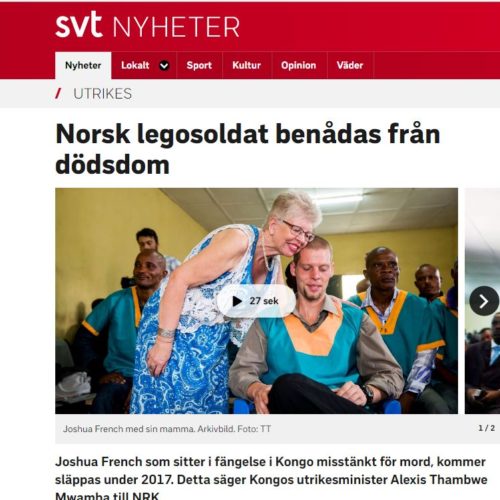
The airport in Kisangani looked like it had gone through all levels of the hell described in Dante’s inferno. This revelation and the heat hit us badly, as did the officials of the airport. Even though the worst of the cleptocracy created by the former dictator Mobutu Sese Seko is gone, officials still spend a fair amount of time trying to find faults in the passports belonging to travelers. This time, correctly though, they noted that Olly and Patrick´s visa was overdue by a day. If it hadn´t been for Kennedy´s extra ordinary contacts and skills, that could have ended with Olly and Patrick in a dreary prison cell, whilst Jeff and me enjoyed the entertaining Kisangani street life seen from a bar in the center of town. I say dreary, because I found out, at the bar, that two Norwegians are imprisoned in this out back and far beyond town.

“It is two young men who just got a bit a stray, they wanted a bit of adventure and things went terribly wrong” , a Norwegian from their Angola Embassy said whilst gulping down a cold beer, “They are not doing to well at all. They´re freaking out and are terrified that they will be moved to the prison on the other side of the river. It is supposedly even worse than here on this side.”

Some 1,300 miles from the mouth of the Congo River, Stanley founded the area’s first trading post for King Leopold II of Belgium in December 1883. The city was known first as Falls Station (or "the Post Stanley Falls" or "The Falls" or simply "Boyoma" the African name of Boyoma Falls) and then with Belgian colonization of the area, it grew into a settlement called Stanleyville (after the explorer Henry Morton Stanley). A city terminus of steamer navigation on the Congo River, the town began as a Belgian trading post. It has been the major centre of the northern Congo since the late 1800s.

Some 1,300 miles from the mouth of the Congo River, Stanley founded the area’s first trading post for King Leopold II of Belgium in December 1883. The city was known first as Falls Station (or "the Post Stanley Falls" or "The Falls" or simply "Boyoma" the African name of Boyoma Falls) and then with Belgian colonization of the area, it grew into a settlement called Stanleyville (after the explorer Henry Morton Stanley). A city terminus of steamer navigation on the Congo River, the town began as a Belgian trading post. It has been the major centre of the northern Congo since the late 1800s.

I have to say, I feel really sad for these two young men. Kisangani isn´t the place where you want things to go wrong. Am also amazed that one of the charges is spying. The question is for what? What in earth could the government of Norway be interested in when it comes to Congo? How to make good matoke? Better to go to Uganda then! Or, maybe they like many other countries are interested in the vast quantities of diamonds that are around Kisangani. At least if one is to judge by the street signs, where every other store seems to deal with diamonds.

“Buy one for your love” , Jeff said, “Then she will never leave you. Diamonds are forever.”

When I passed through here 1989 I was really ill after over eating bananas, pine apple and home made peanut butter. I spent most of my time in a bed at Hotel Kisangani. I saw much more of this extra ordinary place this time. It is really run down after the Mobutu years and two wars, but still has great character in many ways. It is, also, really in the middle of Africa,  it came to fame through Henry Morton Stanley and it is a micro-cosmos of all of the bad and good things of Africa. Everything from poverty to the great African laughter and spectacular natural beauty. The great life line of the continent, the great Congo River, is impressive. This also applies to the last reminiscence of the architecture from the colonial era.

It is also a very hot and humid place. This fact tires you easily and I can understand that as many as 30% of the colonial employees from Belgium, just freaked out after a short while in this area. They couldn´t take it, they almost turned mad. I read a book by a Norwegian journalist, Alfred Henrik Mohn´s book Kongo kallar, about the colonial era. Very interesting. Others returned to Belgium, couldn´t take the life there and returned to Congo. Which I also fully understand. There´s something profoundly deep with this continent, which always makes you extremely run down, but always wants you to return!

Don´t miss this slideshow of this great country!

Africa - it always wants you to return.....

Africa - it always wants you to return.....

The pygmies and Olly

May 28th, 2010 mikael No comments
The former chief of the Mbuti village in Epulu....

The former chief of the Mbuti village in Epulu....

“Is the molimo still part of your world?” I asked and managed to make him surprised!

“The molimo…” , he whispered, “….we shouldn´t talk about the molimo. It is hidden out there!”

I was referring to a kind of a holy and spiritual being for the mbuti pygmies, which took the shape of a long object from which one could make different sounds. This instrument is hidden in the forest, their home, only to be seen by the men. Only used once a year at a special celebration. At least according to Colin Turnbull´s excellent book The Forest People. (Which has been recently analyzed and seen in new light, see here!) And since the pygmy in front of me reacted like that, it still exists. Otherwise, life since Turnbull´s book, written at the end of the 1950´s, have changed quite a lot for these fantastic people. At least if I judged by the man in front of me. He was dressed like a smaller version of Mobutu Sese Seko, the former dictator of Congo, and sported a hat worn by Muslims.

“They do anything for money” , a friend of mine added, “because when the Muslims arrived here to Epulu, they offered money to people who became Muslims. And for the money they can buy alcohol.  They don´t know anything about the outside world. this guy doesn´t even know his own age if you ask him. They are like animals.”

The Mbuti Pygmies of Congo's Ituri forest have survived a brutal civil war and chaotic aftermath. But peace—with its inevitable land rush—poses an even greater threat.

The Mbuti Pygmies of Congo's Ituri forest have survived a brutal civil war and chaotic aftermath. But peace—with its inevitable land rush—poses an even greater threat.

The guy he pointed to was no taller than 140 cm, looked really rough and one could easily see traces in his face of far too much alcohol consumption. He looked pretty much like a guy I remember meeting at the same place, at the Epulu Station, 21 years ago. The first time I came across these extra ordinary people. Most of them I met at the station were they worked by collecting leaves for the okapi. Or where they like these fellows, hanged around hoping they could get something out of the tourists. Either selling arrows, bows or some kind of a handover. But like back than, they were only a fraction of the pygmies in this area. And like than, everyone had an opinion about them. They were childish, naive, easy to fool or like animals. Depending on who you talked to.

“Oh, they do smoke a lot of marijuana!”,  my very good friend Olly Steeds said when he finally turned up in Epulu and we met after just missing each other for a week, “But they are a great people! And it seems like they have preserved their knowledge how to survive in the forest by hunting and gathering.”

Olly had spent five days with a group of mbuti hunters, who were still catching their prey with big, 30 meter long nets. Their camp was a bout half an hour away. There was one even closer, just quarter of an hours walk away from the station, a permanent village, located just a bit away from the real Epulu Village. We all went over there in the evening and we walked into a life where they partly lived in their traditional huts made out of twigs and big leaves, and partly in new houses. The women were working as usual and the men sat around smoking. A young, well dressed pygmy greeted us. He was the new chief of the village and he had also taken Jesus to his heart.  His father came over, who used to be the former chief, and shook hands. he had a white beard and look as wise as a former village chief should look like. It didn´t take long until the women started to sing during their work in an amazing series of sounds! All smiling and laughing. Like all native people, they´re so easy to meet and be together with. Just curious and relaxed. Suddenly the sky opened and rain and thunder arrived. So we returned quickly back to the station but returned next day again. A visit which is a high light in my life.

The play they set up, which depicts the rebell leader Bemba attacking the village, drinking the blood of virgins.

The play they set up, which depicts the rebell leader Bemba attacking the village, drinking the blood of virgins.

It was drizzling slowly when we walked into the village, met a young girl, painted white on body and face, wearing a skirt made of leaves and she danced slowly to the monotonous beat of the drum. After awhile the whole village joined in, so did we, dancing in a ring, whilst the elders of the village, smoked and watched us closely. Suddenly, the dancing stopped and the village kind of split up in two groups and did kind of a theater play, where the storyline was easy to follow and it was played at great suspense. It was the former rebel leader Bemba attacking the village, eating the blood of the virgins, after having cut their heads off.

They finished our visit by singing in the traditional way of an African church choir. Very strong, very moving and very spectacular. We left the pygmies feeling very extra ordinary and privileged. Exactly as I did 21 years ago.

For more info about the pygmies, read this excellent summery from National Geographic.

See this slide show from Congo!

The Jane Goddall of the Okapi – Rosmarie Ruf!

May 24th, 2010 mikael 1 comment
The Okapi (Okapia johnstoni; pronounced /oʊˈkɑːpɪ/) is a giraffid artiodactyl mammal native to the Ituri Rainforest, located in the northeast of the Democratic Republic of the Congo, in central Africa. Although the okapi bears striped markings reminiscent of the zebra, it is most closely related to the giraffe. Unknown to Europeans until 1901, today there are approximately 10,000–20,000 in the wild and only 40 different worldwide institutions display them

The Okapi (Okapia johnstoni; pronounced /oʊˈkɑːpɪ/) is a giraffid artiodactyl mammal native to the Ituri Rainforest, located in the northeast of the Democratic Republic of the Congo, in central Africa. Although the okapi bears striped markings reminiscent of the zebra, it is most closely related to the giraffe. Unknown to Europeans until 1901, today there are approximately 10,000–20,000 in the wild and only 40 different worldwide institutions display them

“I remember…” , I said, “…when I passed through here 21 years ago, I met a friendly fellow named Karl Ruf, who had 2 chimpanzees.”

“That was my husband” , the woman who had presented herself as Rosmarie answered sadly, “He died three years ago in a car accident in Uganda.”

I was talking to a legend. Rosmarie Ruf is one of these rare human beings who has devoted most of her life to a cause to preserve one of this planets unique species. In her case; the very odd looking animal called okapi. She has spent the last 27 years living in the middle of the darkest Africa, next to a small charming river called Epulu.

“My husband came here from Basel zoo and was supposed to stay for a short while, but we ended up making this our life” , she told us during our far too short visit at this little heaven for okapis and pygmies, “and I really hope we have made, and still can make a difference, because this area is under a constant threat from a lot of things.”

” I am amazed that you haven´t received the same attention globally for your work as Jane Godall and Dian Fossey!” I exclaimed, but that didn´t bother Rosmarie.

She hadn´t chosen this life in the middle of Africa to get famous. But to save the unique okapi for the future generations to enjoy. It is the oddest looking of animals. It has the head of a giraffe, but the first detail you notice about this shy animal, is the stripes on its front and back legs, making one think about the zebra. But it belongs to the giraffe family, which is easy to understand when you see its enormous tongue finding the right leaves to eat.

“I remember when I passed through here 21 years ago on a bicycle, that to be able to survive, their diet was made up of 27 different leaves. And that the only ones who knew which ones, where the pygmies. And you had a team of them, looking for them everyday. Is it still like this?” I asked Rosmarie whilst she showed us around the Epulu station.

“Yes, we have a team of them going out each day, and since we have 14 okapis in captivity here and they eat about 4 kg:s of leaves a day, it takes a lot of work to collect this. And the local pygmies do this job and bring it back to the park, where another team assembles them perfectly for each okapi.”

Rosmarie Ruf - a human extra ordinary

Rosmarie Ruf - a human extra ordinary

Another observation which struck me with this extra ordinary looking animal, was how incredibly silent it was whilst walking and how well it was camouflaged whilst slowly, effortless and elegantly moving around this rain forest in the middle of the darkest Africa. Just like the pygmies. The okapi was unknown to the outside world until 1901 and even though it is estimated that there could be around 10 000 of these unique animals in this area, they are somewhat under threat of extinction. The wars, the rebells, logging and the uncertainty of the future of this country, make it a big worry. Even though we live in a very much more accessible world today, Epulu is still stuck in the middle of nowhere. And getting there is still, if you don´t fly in and out in a small airplane, a hardship involving long hours on the earths worst roads. When it comes to the roads, even though the Chinese are slowly turning the countries roads into passable, they haven´t changed a bit since I literally slogged through here 21 years ago. BUT, it is still the real Africa, which is still possible to enjoy! And the area around Epulu is unique on this earth!

I admire people like Rosmarie Ruf, who give their life to a cause to preserve something unique. And by that giving up a comfortable life in the West. Far away from family and roots. And on top of that, knowing that she is living in the middle of Africa, has been under a lot of personal threat due to the wars and she still is there, and most likely will be for the rest of her life, that makes me think that she is one of the most fantastic human beings I have come across. Epulu is unique!

The rangers at Epulu note down every single leaf, every single bundle and which pygmies showed up that day.

The rangers at Epulu note down every single leaf, every single bundle and which pygmies showed up that day.

Goma- badly affected by war and nature!

May 21st, 2010 mikael No comments
n January 2002, Nyiragongo erupted, sending a stream of lava 200 metres (219 yd) to one kilometre (1,100 yd) wide and up to two metres (6½ ft) deep through the center of the city as far as the lake shore. Agencies monitoring the volcano were able to give a warning and most of the population of Goma evacuated to Gisenyi. The lava destroyed 40% of the city (more than 4,500 houses and buildings).

n January 2002, Nyiragongo erupted, sending a stream of lava 200 metres (219 yd) to one kilometre (1,100 yd) wide and up to two metres (6½ ft) deep through the center of the city as far as the lake shore. Agencies monitoring the volcano were able to give a warning and most of the population of Goma evacuated to Gisenyi. The lava destroyed 40% of the city (more than 4,500 houses and buildings).

“Even though we were warned on the radio, some people just didn´t leave in time” , Emmanuel told us while he gesticulated frenetically with his arms, indicating how the hot lava spread over the town of Goma, “They ran for the cathedral and thought hiding inside would save them. It didn´t. They fried to death.”

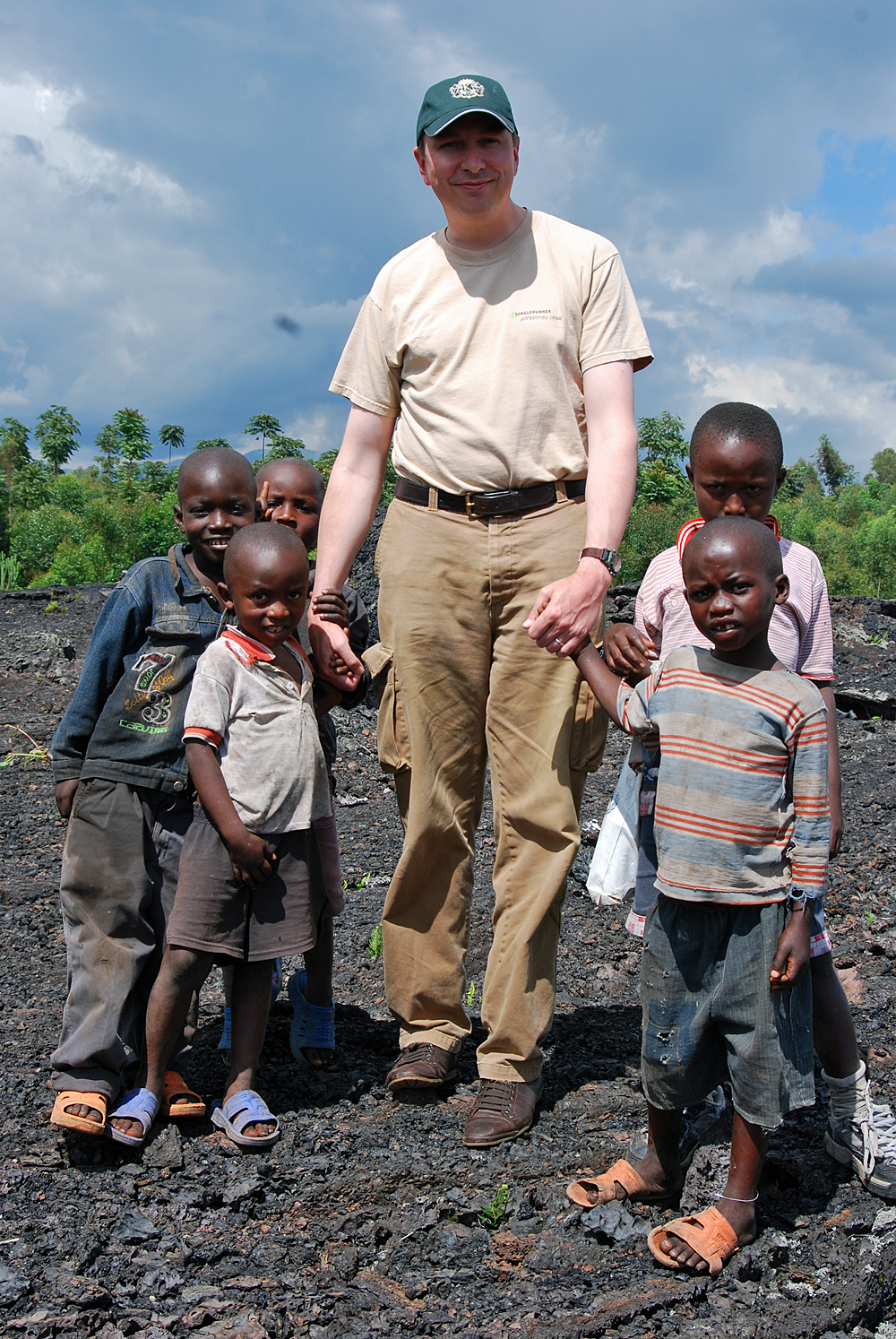
We were all standing on top of an outcrop of sharp black lava, where the eruption had started in January 2002. It was Emmanuel, our guide, Jeff and me, a very passionate local woman who saw herself as the caretaker of the area and about a dozen kids in awe of what they called monics. (mispronunciation of United Nations mission in Congo, MONUC) The lava had just broken through the ground where we were standing, about 10 km:s south of Nyarigongo Volcano, but at the edge of this unfortunate town.

“The lava stream was one kilometer wide and up to two meters deep and it just went through the whole town ending up with a great fizz in Lake Kivu.”

I looked to the north, were the perfect coned shaped volcano Nyarigongo, looked as calm as an active volcano can look like. Just a small cloud covering it, a bit of smoke crawling out of the caldera we had stood on a few days earlier. I turned my eyes back to the south and saw a wide black line of dried lava shooting through the town. Goma probably has one of the most beautiful settings in the world, at the foot of a string of volcanoes which forms Virunga National Park and overlooking the charming Lake Kivu. But it is a town which has suffered badly from the effects of the eruptions and from the two wars of 1996-97 fuelled by the Rwandan Genocide. We left the eruption area, went back to the dusty road, paid a few “fees” for our visit and started one of the oddest city tours I have ever done. But also one of the most interesting.!

It was in one way, a trip through the lives of many unfortunate, struggling people, who´s lives had been totally ruined. It was a tour plagued by rubbish everywhere, poverty, kids with signs of kwashiorkor, the thinnest of dogs, ramshackle homes and stores, extremely pot holed dirt roads and enormous amounts of people just trying to figure out how to go ahead with daily life. There were many fortunate ones. They kind of hid in homes covered by barbed wire and guards, as where all of UN:s deposits around town. Their presence could be seen everywhere. Troops came from Uruguay, Pakistan and India. I even heard Swedish spoken.

Is this tourism?

Cruising through Goma....

Cruising through Goma....

In my mind, absolutely. For me tourism is showing reality, creating understanding and finding ways to build bridges between cultures. And even though, for somebody with a very negative attitude to the realities of life, sure, it was a lot of misery. But, amongst all this, there was a everlasting feeling of hope, possibilities and pioneering. People were starting to rebuild their lives, by setting up what it looked like, very unstable structures, homes, on top of the dried lava. Others were transporting enormous loads of fruit, building material, cassava, on home made bicycles of wood. Small businesses were starting up everywhere. On sale was second hand clothes, cassava, loads of pine apple, beer and lots more. Things were happening and the one feeling which always have dominated my time in Africa is that the Africans are extra ordinary resourceful people and always find ways to survive and live in dignity. And they still know how to laugh!

It was definitely a tour of hope!

But, except mobile phones, and to be fair to reality, not a lot had changed in those 21 years since I passed through on my push bike. Congo, of course, have gone through a lot of upheaval, at least two wars, Mobutu was dead and gone and a new president had arrived, the son of Laurent Kabila, Joseph. As far as I can understand, the governing by cleptocracy that was Mobutu’s legacy, is far from gone. Many Congolese we conversed with, talked themselves warm for Paul Kagame, the president of Rwanda, a country modernizing quickly. I can understand they want change! Just crossing the border to the twin city of Gisenyi on the other side, was quite dramatic. In reality, this area was once part of the great kingdom of Rwanda and many of the inhabitants are of course Tutsi and Hutu. The Belgians, like other colonial powers, didn´t care about such things and made their borders without thinking about the tribal identities in the area.

“Is it safe to visit this area?” I asked Emanuel, which echoed what his boss Kennedy and pretty much everyone else we´d come across during the visit in this region, ” Yes! The last insurgents left the area half a year ago and we welcome tourists again!”

“And the Hutu FDLR-rebells have left as well?” I asked, and Emanuel answered: “Yes, but some or still hiding away in the mountains and forests north and west of the town, but are easily avoided. ”

The recent history of Goma has been dominated by the volcano and the Rwandan Genocide of 1994, which in turn fuelled the First and Second Congo Wars. The aftermath of these events was still having effects on the city and its surroundings in 2010.

The recent history of Goma has been dominated by the volcano and the Rwandan Genocide of 1994, which in turn fuelled the First and Second Congo Wars. The aftermath of these events was still having effects on the city and its surroundings in 2010.

Of course, if you read on the Internet, and the recommendations of the British and American Embassies,  its almost on pair with Yemen, which is one of the safest places I have ever visited. Congo is one of the most fascinating places on earth, for me the real Africa, and just have to be visited! And like Kensington Tours moving in just six months after the last disturbance, is very brave and shows why I want to work with them. They move the limits what is possible and offer something utterly unique. My feeling, travelling through Congo, is that it is almost unspoilt by tourism! Not many places you can get those feelings nowadays!

And Goma feels very safe, very stable, but one major difference have occurred since I passed through 21 years ago. Somebody said that the Congolese have lost their innocence through the wars and taking photos is a major obstacle. There´s no doubt, there´s a more aggressive attitude formed, which is very understandable.

Goma is probably one of the most interesting places on earth right now!

And, not only that, Goma is the birth place of Innocent Balude, the 13-year old which is the number one super star in Congo right now, see why here!

Jeff Willner had big visions and a big heart....he is the leader and founder of Kensington Tours. A very good friend of mine today!

Jeff Willner have big visions and a big heart....he is the leader and founder of Kensington Tours. A very good friend of mine today!

Climbing Mount Nyiragongo in Congo!

May 17th, 2010 mikael No comments
walking_thorugh_forest_nyarigongo

Jeff and the guards slogging their way through the dense rain forest which covers the lower part of this magnificent volcano.

“I hate this posting!” shouted one of the guards when we slogged through the first part of the climb, dense and wet bush, “I wanted to get a posting at the gorillas, where you don´t have to work as hard as this. Oh, no, I end up at the worst posting for a Congolese park ranger – climbing the volcano Nyiragongo with some slow tourists!”

When Jeff translated this quote from Swahili to English I fully understood the guards opinion. I found the going rough as well. For once in a long time I felt upset with Pamela´s fantastic cooking. It had made me put on an enormous 7 kg:s of fat in just 6 months! And I asked myself:

“I won´t make it to the top with all these cameras and I will look like a fool in Jeff’s eyes if I can´t make it!”

Jeff Willner was a revelation in many ways. He used to be a missionary kid here in Congo and spoke fluent Swahili. He was also one of the kindest, most generous and intelligent people I have met in a long time. This was my first job as a explorer-in-residence at Kensington Tours, the bravest and most interesting of tour operators in the world right now. Six months after the end of the instability in the region, Jeff himself, the owner, moves in, in person, to Congo to see if he can help the country by bringing in tourism. He said he saw himself as an armchair explorer nowadays, but is a well known explorer in his own right, after having done a great Expedition by Landrover together with three ladies. And he pushed on like he was possessed!

“We have to get up and down in one day, Mikael!” he shouted as the extraordinarily occupied owner he was, “I don´t have more time!”

We had been waiting for three days to get the permission to climb this very active volcano which had its last devastating eruption 2002. Nothing is easy in Congo, but everything is possible. If you have the right contacts. Like Kennedy at Hakuna Matata Tours. We wanted to climb the volcano to see if it should be a must on any itinerary for a tourist in this the most fantastic of places on earth. Congo is no doubt one of the most interesting countries on earth right now. Believe me. For somebody like me who have been there, done that, there´s nothing like it. In comparison, I think only Yemen can rival. And Nyarigongo is a very beautiful and still active volcano with big pools of lava at the bottom of its caldera. That is, if one makes it to the top….

jeff_climbing_through_senecia_forest_nyarigongo

"Jeff Willner was a revelation in many ways. He used to be a missionary kid here in Congo and spoke fluent Swahili. He was also one of the kindest, most generous and intelligent people I have met in a long time."

The first part, from the very basic ranger station, up to a small plateau, takes the walker through dense and muddy rain forest. It is so dense, so it is easy to understand that since the war 1996-97, tourism has been all but gone. One gets this great feeling of being one of the first to travel through this area!

After about two hours of slippery, wet and arduous climbing we reached a small plateau offering spectacular views over Lake Kivu and Bukavu.

“2 hours to ago to the top!” whispered our guide Roger, “Mikael, do you need help to carry your rucksack?”

“Maybe you should let them help you,Mikael?” Jeff added.

I said no of course and raced on up through, by the meter, steeper climb. Volcanic stone is really sharp and kills any shoe quickly. But worst was the heat and humidity. Whilst trashing through the forest, humidity and weight made me sweat profusely, but now, once out in the open, I missed the cooler forest. The sun just baked on and we were beginning to feel the altitude.

“I have headaches”, Jeff said, which gave me some joy to see he was suffering as well, “Doing this in one day is too much!”

There´s no doubt, that to be able to fully enjoy the great scenery and variety of ecological zones one passes through on the climb up to the 3,470 m (11,385 ft)  top, two days is the optimal. The last two hours brought us through some great scenery and landscapes, dominated by gigantic lobelias and senecio plants. Once we reached the top, clouds moved in after a heavy rain, and we could finally look down into the enormous crater. Suddenly, the clouds dispersed and we could see three gigantic lava pools fuming with orange heat! It is an extra ordinary experience to see this!

After having a great lunch just below the crater, Jeff shot off down the volcano like a rocket! He wanted to get down as fast as possible so that he could enjoy a Cuban cigar and a Green Label whiskey at the hotel pool. It only took us two hours to make it all the way down! Six hours up and two down. Even the moaning park rangers liked that!

The climb is demanding, but well worth the effort. It should definitely be part of any itinerary in East Africa!

Read more about the volcano here!

And, why not see this little film with the new Congolese superstar to be? Innocent Balude!

Once we reached the top, clouds moved in after a heavy rain, and we could finally look down into the enormous crater. Suddenly, the clouds dispersed and we could see three gigantic lava pools fuming with orange heat! It is an extra ordinary experience to see this!

Once we reached the top, clouds moved in after a heavy rain, and we could finally look down into the enormous crater. Suddenly, the clouds dispersed and we could see three gigantic lava pools fuming with orange heat! It is an extra ordinary experience to see this!